

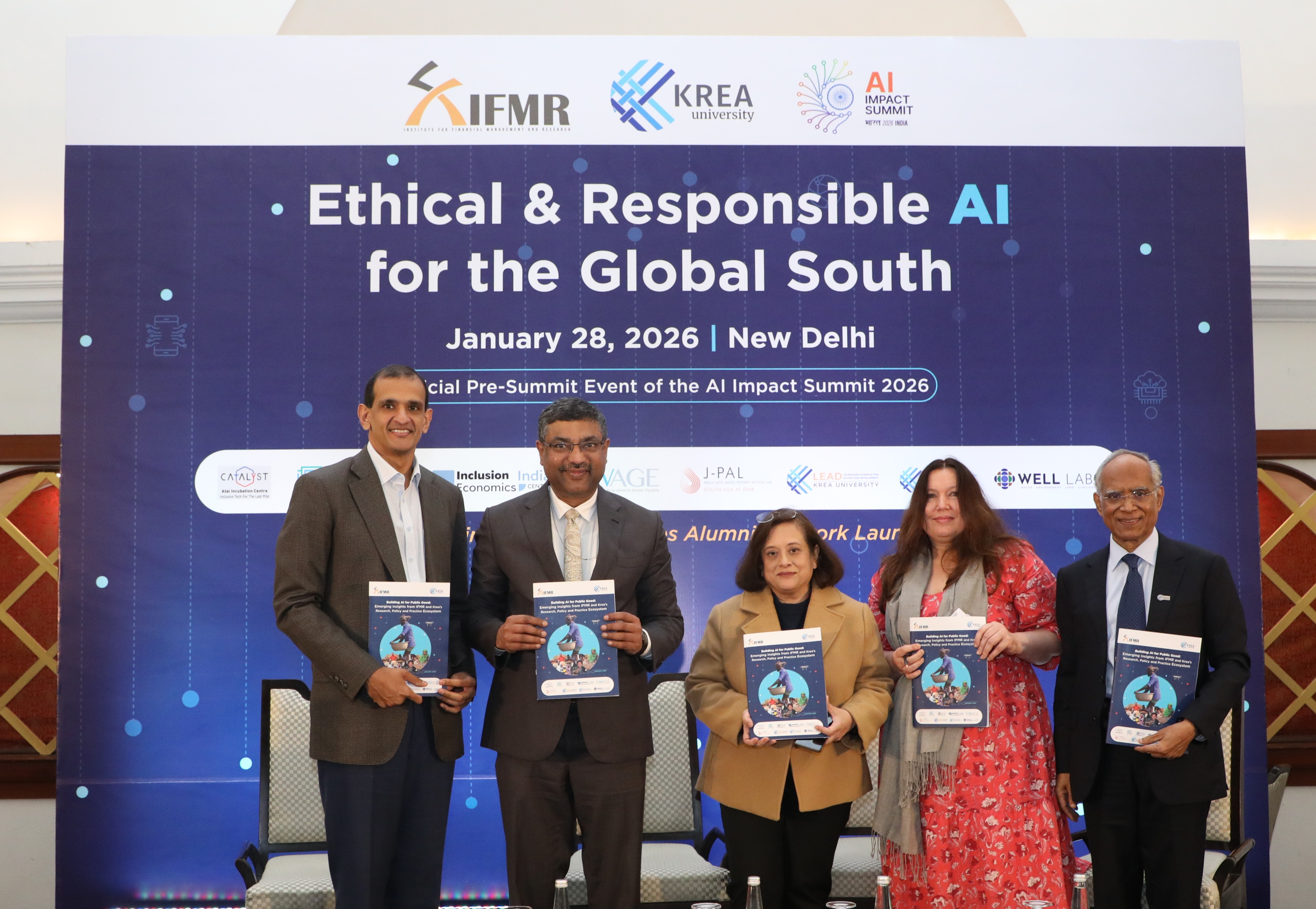

New Delhi Jan 29: The IFMR–Krea University ecosystem convened senior policymakers, academic leaders, and practitioners in New Delhi for a high-level dialogue on Ethical and Responsible AI Leadership for the Global South, held as an official pre-summit engagement ahead of the India AI Summit 2026. The dialogue brought together distinguished speakers from government, academia, and the technology and development ecosystem, including Shri S. Krishnan, Secretary, Ministry of Electronics and Information Technology (MeitY); Debjani Ghosh, Distinguished Fellow, NITI Aayog and Chief Architect, NITI Frontier Tech Hub; Lakshmi Narayanan, Chancellor, Krea University; and Mukund Padmanabhan, Distinguished Professor, Krea University and Former Editor, Hindu.
Key themes emerging from the convening included an impact-first, inclusive approach to AI—focused on democratising access to AI capabilities, data, and infrastructure; strengthening evidence, data quality, and analytical capacity; and embedding ethics and accountability by design, building interdisciplinary talent and research ecosystems for AI for public good, and centering Global South perspectives in the AI discourse.
The event marked the launch of a compendium featuring emerging insights from across IFMR and Krea’s research, policy, and practice ecosystem on AI and digital technologies for inclusive development.
Shri Kapil Viswanathan, President, IFMR; Shri S. Krishnan, Secretary, Ministry of Electronics and Information Technology (MeitY); Ms. Debjani Ghosh, Distinguished Fellow, NITI Aayog and Chief Architect, NITI Frontier Tech Hub; Ms. Sharon Buteau, Executive Director, LEAD at Krea University;
Shri Lakshmi Narayanan, Chancellor, Krea University.
Secretary, Ministry of Electronics and Information Technology (MeitY), Shri Krishnan articulated the core principles underpinning India’s approach to AI. “Leveraging AI and digital technologies effectively will be critical to achieving the vision of a Viksit Bharat by 2047, particularly through innovation and high-impact use cases that address real challenges on the ground. Our approach to AI is anchored in inclusion and impact, with a focus on making AI resources, capabilities, and benefits widely and democratically available, and on deploying solutions meaningfully across sectors such as healthcare, agriculture, education, governance, and livelihoods to deliver measurable impact in the field. In this regard, the forthcoming AI Summit is a unique collaborative platform, bringing together government, researchers, industry, and practitioners, bringing forth impactful use cases and applications.”
Emphasising the importance of institutional learning, Chancellor of Krea University, Shri Lakshmi Narayanan noted that “Artificial intelligence is not just changing technologies, it is reshaping how societies imagine progress. Engaging responsibly with AI also demands new institutional capabilities and learning frameworks. At Krea University, we believe this choice depends on grounding AI in human values, ethical reasoning, and long-term stewardship of both people and the planet. This also calls for a culture of continuous learning and iteration—where institutions can experiment, reflect, and adapt as AI evolves.”
Speaking about IFMR’s research ecosystem, President Shri Kapil Viswanathan, noted that “IFMR’s work has always been grounded in translating research into institutional and policy impact. This convening and the compendium bring together grounded examples where implementation realities and social context shape AI outcomes, reflecting our long-standing commitment to policy-engaged, applied research. We hope this work continues to surface critical questions, bridge knowledge gaps, and inform Global South efforts to design and deploy AI technologies that deliver public value, through our collaborations with governments, practitioners, and philanthropic organisations.”
The convening also marked the launch of the IFMR Centres Alumni Network, bringing together alumni from IFMR’s research centres to foster collaboration, mentorship, and cross-sector engagement around India’s development priorities.