New Delhi, Nov 17: India and Egypt have agreed to work towards increasing bilateral trade to $12 billion and explore the possibility of a Preferential Trade Agreement (PTA), Free Trade Agreement (FTA) or Comprehensive Economic Partnership Agreement (CEPA), signalling a renewed push to deepen economic and industrial ties between the two countries.
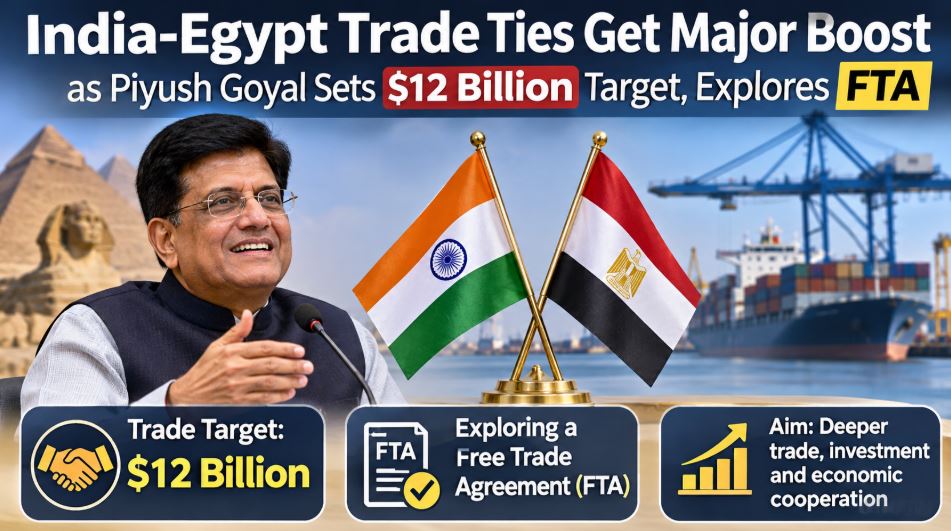

Representational Image
The understanding emerged during Union Commerce and Industry Minister Piyush Goyal’s two-day official visit to Egypt from November 15 to 16, 2026, which saw a series of high-level political engagements, business meetings and discussions on expanding investment opportunities.
A major outcome of the visit was the decision to establish a joint working group to examine the framework and terms of reference for a potential trade agreement. The proposed arrangement would cover goods, services and investment, with both sides agreeing to assess the mutual benefits before moving forward.
The visit also marked the first time Goyal undertook a bilateral visit to an African country, underlining India’s growing economic engagement with the African continent.
Bilateral trade rises 64 per cent
At the centre of the discussions was the ambitious target of raising India-Egypt bilateral trade to $12 billion. Both countries agreed to diversify their trade basket, encourage higher value-added exports, improve market access and address barriers affecting businesses.
The momentum is already reflected in trade figures. Bilateral merchandise trade reached $5.04 billion during April-September 2026, registering a 64 per cent increase over the corresponding period last year.
During FY 2025-26, India’s exports to Egypt stood at $3.87 billion, while imports from the North African country amounted to $2.60 billion, according to data from the Directorate General of Commercial Intelligence and Statistics (DGCIS).
The two sides identified several sectors with potential for greater cooperation, including pharmaceuticals, engineering goods, chemicals, petrochemicals, fertilisers, textiles, agriculture, renewable energy, healthcare, logistics and services.
The discussions also addressed practical trade-related concerns, including registration of Indian ceramic tile companies with Egypt’s General Organisation for Export and Import Control (GOEIC), pending commercial payments, trade remedies and Indian companies’ participation in Egyptian public procurement tenders.
$5 billion Indian investment presence in Egypt
Investment cooperation emerged as another significant area of engagement. Around 70 Indian companies are currently operating in Egypt, with cumulative investments estimated at approximately $5 billion.
Egypt invited greater Indian participation in investment opportunities, particularly in the Suez Canal Economic Zone (SCZONE), which offers opportunities for manufacturing, trade and export-oriented industrial development.
Key sectors identified for potential investments include automotive manufacturing, auto components, pharmaceuticals, chemicals, textiles, food processing, engineering, renewable energy and logistics.
Both countries also agreed to promote industrial partnerships and joint ventures in renewable energy, green hydrogen, fertilisers, pharmaceuticals, textiles, automotive components and digital transformation.
The discussions reflected a shared interest in moving beyond conventional trade towards deeper industrial collaboration, technology partnerships and stronger business-to-business connections.
UPI-Instapay linkage and digital cooperation on agenda
Digital technology and financial innovation featured prominently in the discussions, with both sides recognising the potential for linking India’s Unified Payments Interface (UPI) with Egypt’s Instapay platform.
The proposed digital payments cooperation could strengthen cross-border financial connectivity and make transactions easier for businesses and consumers.
The two countries also discussed the potential role of trade in local currencies in facilitating exports and reducing transaction-related challenges. India’s experience in Digital Public Infrastructure (DPI) was highlighted as a possible model to support Egypt’s digital transformation.
These areas of cooperation could open new avenues for fintech companies, technology startups and financial service providers in both markets.
Business forum draws over 250 participants
Goyal also participated in the sixth India-Egypt Joint Business Council meeting and the India-Egypt Business Forum alongside Egypt’s Minister of Investment and Foreign Trade, Mohamed Farid Saleh.
The meeting brought together more than 250 representatives from Indian and Egyptian businesses, providing a platform to explore new investment opportunities, commercial partnerships and industrial collaborations.
Discussions focused on pharmaceuticals, chemicals, food processing, agri-business, renewable energy, green hydrogen, infrastructure, ports, logistics, information technology, textiles and automotive manufacturing.
The business engagements highlighted the importance of stronger private-sector participation in translating the growing diplomatic relationship into concrete commercial opportunities.
Nearly 50 startups explore cross-border partnerships
The startup ecosystem was another important focus of the visit.
On November 16, Goyal participated in the India-Egypt Startups Forum alongside Egypt’s Minister of Planning and Economic Development, Ahmed Rostom.
The forum brought together nearly 50 startups from both countries, along with incubators, accelerators, venture investors and government representatives.
Entrepreneurs explored collaboration in digital payments, affordable healthcare, agriculture, tourism and emerging technologies.
During a startup roundtable, Indian founders presented their solutions for the Egyptian market and highlighted their requirements for expanding operations, including distribution partners, pilot projects, product certification and local manufacturing support.
The discussions aimed to create stronger links between startup ecosystems and encourage innovation-led partnerships, investment and job creation.
Goyal also highlighted India’s startup journey and the role of digital public infrastructure and supportive policies in building a dynamic entrepreneurial ecosystem.
Focus on infrastructure, transport and manufacturing
During the visit, Goyal held meetings with several senior Egyptian leaders, including Prime Minister Mostafa Madbouly, Minister of Investment and Foreign Trade Mohamed Farid Saleh, Industry Minister Khaled Hashem, Foreign Minister Badr Abdelatty, Planning and Economic Development Minister Ahmed Rostom and Transport Minister Kamel Wazir.
The discussions covered trade, investment, industrial development and opportunities for cooperation in infrastructure.
Potential areas included port modernisation, shipbuilding, greenfield and brownfield airport development, and affordable, high-quality metro rail systems.
Goyal also met Egyptian business leaders and chief executives to explore opportunities for Indian companies to expand their presence and establish partnerships in Egypt.
In a separate engagement, he met Mohamed Ismail Mansour, Chairman of Infinity Energy, to discuss potential collaboration in automotive manufacturing, electric vehicles, auto components, fintech, digital payments, renewable energy and logistics.
Goyal said India’s expanding market, manufacturing capabilities, skilled workforce and investment environment offered significant opportunities for Egyptian businesses seeking to participate in India’s growth.
Indian businesses look towards wider African opportunities
The visit also provided an opportunity to strengthen India’s commercial engagement with the wider African market.
An accompanying Indian business delegation held discussions with representatives of the African Export-Import Bank (Afreximbank) on project preparation, project financing, advisory services, capital markets, export development, industrial parks and the Africa Trade Gateway.
The interaction explored opportunities for Indian companies to use the bank’s financial and institutional network to expand their engagement across African markets.
Goyal also interacted with members of the Egyptian Junior Businessmen Association, comprising entrepreneurs from prominent Egyptian family-owned businesses, along with Indian companies operating in Egypt.
The discussions focused on developing entrepreneurial partnerships, encouraging business exchanges and identifying new avenues for bilateral cooperation.
Next Joint Trade Committee meeting in New Delhi in 2028
The seventh session of the India-Egypt Joint Trade Committee (JTC), co-chaired by Goyal and Egyptian Minister Mohamed Farid Saleh on November 15, was elevated to the ministerial level, reflecting the growing importance attached to economic engagement between the two countries.
Both ministers signed the agreed minutes of the meeting, while the next JTC session is scheduled to take place in New Delhi in 2028, or earlier if mutually agreed.
During his engagement with the Indian community in Egypt, Goyal also acknowledged its contribution to strengthening people-to-people and commercial relations.
He invited Egyptian businesses and investors to participate in the Vibrant Gujarat Summit 2027 in Gandhinagar and Bharat Mobility 2027, scheduled to be held in New Delhi from February 4 to 9.
A stronger India-Egypt economic partnership
India and Egypt elevated their relationship to a Strategic Partnership in 2023, creating a broader framework for cooperation across political, security, economic and cultural sectors.
Goyal’s latest visit has added fresh momentum to that relationship, with a clear emphasis on expanding trade, attracting investments, strengthening manufacturing links and promoting cooperation in emerging technologies.
With bilateral trade recording strong growth, Indian investments in Egypt already reaching around $5 billion and both governments exploring a potential trade agreement, the two countries are seeking to build a more comprehensive economic partnership.
The proposed $12 billion trade target, if achieved, would mark a significant step in India’s efforts to deepen its economic presence in Africa while opening new opportunities for Egyptian businesses in one of the world’s fastest-growing major markets.