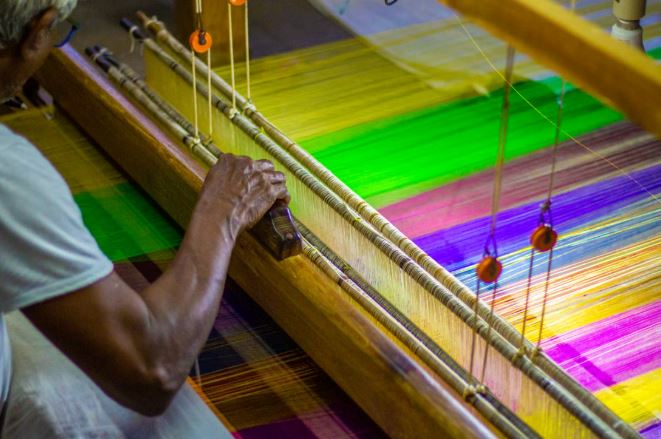

Pic Credit: Pexel
India’s handloom industry is entering a new phase of commercial opportunity as global textile businesses and consumers increasingly look beyond mass-produced fabrics for products that offer originality, craftsmanship and a distinct identity. What was traditionally viewed primarily as a heritage-based rural industry is gradually finding relevance in premium fashion, international home furnishing, designer retail and sustainable lifestyle markets. For Indian businesses, this shift presents an opportunity to turn traditional weaving capabilities into a more competitive, export-oriented industry.
The sector has a significant economic foundation. India has approximately 35.22 lakh handloom weavers and allied workers, with women accounting for more than 72% of the workforce. Its production network extends across thousands of rural households and specialised weaving clusters, creating a diverse supply base for domestic and international buyers. However, the industry’s commercial potential remains considerably larger than its current export presence.
The business opportunity is no longer limited to selling traditional sarees, fabrics and shawls. Contemporary fashion, luxury interiors, boutique hospitality, customised textiles and online retail are opening new avenues for handloom enterprises. The challenge is to make these traditional products commercially relevant to modern consumers while preserving the craftsmanship and regional identity that distinguish them.
Global Fashion and Lifestyle Markets Are Creating New Demand
The international textile market is experiencing a gradual shift towards differentiated products, responsible sourcing and distinctive design. Consumers are increasingly interested in understanding where products come from, how they are made and what makes them different from standardised alternatives.
This changing preference offers Indian handloom businesses an opportunity to compete in specialised market segments. Unlike large-scale textile manufacturing, handloom production can accommodate intricate patterns, limited-edition collections, customised designs and region-specific weaving techniques.
Traditional Indian textiles such as Banarasi silk, Sambalpuri Ikat, Chanderi, Kanjeevaram and Pochampally Ikat can be positioned for international designer collections, premium clothing and contemporary home interiors.
For exporters, the commercial strategy should focus on presenting these products in formats that appeal to overseas customers. A traditional woven fabric, for example, can be developed into contemporary dresses, scarves, jackets, upholstery and decorative furnishings.
This approach allows businesses to move beyond conventional product categories and reach customers who may not otherwise purchase traditional Indian textiles.
Export Growth Signals Opportunities for Indian Textile Businesses
India’s handloom export industry is gaining commercial attention, although its international presence remains relatively small compared with the country’s wider textile and apparel business.
Handloom product exports reached approximately ₹1,359 crore in FY2025–26, compared with around ₹1,175 crore in the previous financial year, reflecting growth of approximately 13.2% in rupee terms. The United States, the United Arab Emirates, France, the United Kingdom and Spain are among the important overseas markets.
An interesting development is the changing geographical distribution of demand. The UAE has strengthened its position as a major destination, with Indian handloom exports to the market reaching approximately US$44.8 million in FY2025–26. Meanwhile, the United States accounted for around 48.33% of India’s handloom exports during April–July 2026–27.
These developments underline the importance of market diversification. Indian exporters have opportunities to expand their presence in West Asia, Europe, North America and other international markets by developing products suited to local purchasing preferences.
The government has also set an ambitious target of taking India’s handloom exports to US$10 billion by 2031. Achieving this would require a substantial expansion in manufacturing capabilities, international distribution, product development and market access.
For businesses, the larger opportunity lies in moving from occasional export orders towards long-term relationships with overseas retailers, fashion labels, interior design companies and institutional buyers.
Home Furnishing and Interior Design Offer Untapped Business Potential
One of the most promising opportunities for the handloom sector is the expansion of its presence beyond traditional apparel.
International demand for distinctive interior products is creating opportunities for Indian weaving businesses to supply curtains, cushion covers, bed linen, table runners, upholstery, rugs and decorative fabrics.
Boutique hotels, luxury resorts, restaurants and premium residential projects represent potential customer segments for customised handwoven textiles. Interior designers and architects can also become important business partners by incorporating regional Indian fabrics into contemporary spaces.
This shift could create more consistent demand for weaving clusters while reducing their dependence on seasonal clothing purchases.
For manufacturers, the segment offers opportunities to develop specialised product collections, establish relationships with hospitality procurement companies and build private-label partnerships with international home furnishing retailers.
Businesses that combine traditional weaving with contemporary colour palettes, functional designs and consistent product specifications can strengthen their position in this growing market segment.
Digital Commerce Is Reshaping the Traditional Supply Chain
The expansion of online retail is changing how Indian handloom products reach customers. Earlier, many artisans depended on local traders, exhibitions and intermediaries to sell their products. This often restricted their market reach and reduced their ability to influence final selling prices.
Digital platforms are creating alternative opportunities. Artisan groups, cooperatives, independent designers and small businesses can now showcase their collections to customers across India and overseas.
The Government’s Indiahandmade platform is one initiative supporting this transition by connecting verified artisans and weavers with buyers. Similarly, approximately 1.50 lakh weavers and handloom entities have been onboarded on the Government e-Marketplace, expanding access to institutional procurement opportunities.
For private businesses, the opportunity extends beyond listing products online. Companies can develop their own digital brands, introduce limited-edition collections, use customer data to understand buying preferences and build direct relationships with international consumers.
However, online visibility alone does not guarantee commercial success. Product photography, accurate descriptions, inventory management, packaging, international shipping and after-sales service must meet customer expectations.
Brands that develop these capabilities can reduce their dependence on traditional distribution networks and establish more direct access to premium customers.
Authenticity Is Becoming an Important Competitive Advantage
As handloom products reach wider markets, establishing their authenticity will become increasingly important.
Machine-made imitations, misleading product descriptions and unauthorised use of traditional designs can undermine the reputation of genuine handwoven products. This creates a challenge for businesses that invest in skilled artisans and authentic production processes.
Geographical Indication recognition offers an important opportunity to protect the identity of region-specific textiles. It connects a product with its geographical origin and the specialised knowledge associated with its production.
The Handloom Mark and India Handloom Brand also help distinguish authentic products and strengthen consumer confidence.
For exporters and premium retail businesses, authenticity can become part of the product’s commercial value. Information about the weaving community, production technique, regional origin and materials can help customers understand why a handwoven textile commands a different price from mass-produced fabric.
Digital product identification and QR-based traceability can further strengthen this proposition by providing buyers with information about the product and its origins.
Technology and Design Innovation Are Changing Business Operations
Traditional craftsmanship remains the foundation of the handloom industry, but modern technology is becoming increasingly relevant to its commercial development.
Digital design tools, artificial intelligence-based trend forecasting, improved weaving equipment and online inventory systems can help businesses respond more efficiently to market requirements.
For example, digital design applications can assist with pattern development and contemporary product adaptation. Data-driven trend analysis can help manufacturers understand changing colour preferences and seasonal demand before developing new collections.
Technology can also improve production planning and reduce coordination difficulties between exporters and multiple weaving clusters.
The establishment of the Centre of Excellence for Handloom Technology at IIT Delhi, supported by an investment of approximately ₹11.99 crore, reflects the growing emphasis on research and technological advancement in the sector.
Initiatives such as Handloom 4.0 are also encouraging the integration of digital tools and innovation into traditional textile production.
For businesses, these developments could create opportunities in textile technology, design consultancy, digital authentication and specialised manufacturing services. The objective should be to improve productivity and working conditions without replacing the manual skills that give handloom products their distinctive value.
Supply Chain Modernisation Will Determine Export Competitiveness
Despite its extensive production base, the handloom industry continues to face operational limitations. A large proportion of production takes place in household units, making it difficult to coordinate large orders, maintain uniform quality and meet strict international delivery schedules.
Export buyers typically expect consistent dimensions, colour quality, finishing, packaging and documentation. Smaller weaving enterprises may lack access to testing laboratories, common finishing facilities, organised warehousing and sufficient working capital.
Developing shared infrastructure across major weaving clusters could help address these challenges. Common facilities for dyeing, testing, finishing, packaging and storage would allow small producers to retain their independent operations while participating in larger commercial orders.
For exporters, building reliable supplier networks is equally important. Long-term arrangements with cooperatives, producer organisations and artisan groups can improve procurement planning and reduce supply disruptions.
Businesses that invest in these capabilities will be better positioned to compete for institutional orders and international retail contracts.
Profitability Must Improve Alongside Artisan Earnings
The industry’s expansion will be difficult to sustain unless commercial growth creates better economic opportunities for weaving communities.
Many artisans continue to face irregular orders, fluctuating raw material costs and limited bargaining power. The time spent on yarn preparation, design development, weaving and finishing is not always adequately reflected in the payment received.
This creates a long-term business risk. If weaving cannot provide a dependable income, younger generations may move towards other occupations, weakening the availability of specialised skills.
For brands and exporters, responsible sourcing should therefore become an integral part of business strategy. Transparent pricing, timely payments and longer-term procurement relationships can strengthen supplier networks while improving artisan livelihoods.
Businesses that work directly with producer organisations can also improve product traceability and establish a stronger connection between craftsmanship and the final retail value.
Fair compensation is not simply a social responsibility. It is essential to maintaining the skilled production base on which the industry’s competitiveness depends.
New Investment Opportunities Across the Handloom Value Chain
The changing business environment is creating opportunities beyond traditional weaving and fabric manufacturing.
Startups can develop specialised handloom brands targeting premium fashion, sustainable clothing and contemporary home interiors. Established textile companies can diversify into regional craft-based collections, while exporters can build specialised sourcing and distribution networks.
There is also potential for investment in:
-
Design and product development: Contemporary collections that combine traditional techniques with modern consumer preferences.
-
Digital retail: Direct-to-consumer platforms and international online distribution.
-
Manufacturing infrastructure: Common facilities for dyeing, finishing, testing and packaging.
-
Authentication technology: Digital identification and traceability solutions for genuine handloom products.
-
Hospitality and interior textiles: Customised fabrics and furnishings for hotels, resorts and commercial properties.
-
Export services: Quality certification, logistics, international sourcing and buyer coordination.
Government support through the National Handloom Development Programme, raw material assistance and cluster-development initiatives can further support enterprises looking to modernise their operations and expand their market presence.
For small and medium-sized businesses, partnerships with existing weaving clusters can offer a practical entry point without requiring large investments in production infrastructure.
India’s Handloom Industry Needs a Stronger Commercial Identity
India’s handloom industry has the skills, regional diversity and production heritage to establish a more significant position in international textile markets. What it needs now is a stronger connection between craftsmanship and commercial opportunity.
The next stage of development will depend on how effectively businesses respond to changing consumer preferences, invest in contemporary product design, improve supply-chain efficiency and build trusted international distribution networks.
For manufacturers, exporters and emerging lifestyle brands, handloom products offer an opportunity to compete through differentiation rather than volume alone. For weaving communities, stronger commercial relationships can create more stable livelihoods and encourage the continuation of traditional skills.
Ultimately, the future of India’s handloom industry will be determined not simply by its ability to preserve traditional weaving, but by its capacity to make that craftsmanship commercially relevant in a changing global marketplace.