
Representational Image
Mumbai: Eighteen years after the horrific terror attacks that brought Mumbai to its knees, November 26 remains more than a date of national mourning. It represents a defining moment in India’s security history, exposing the vulnerabilities of a major urban centre, challenging the country’s intelligence and emergency response systems, and forcing a fundamental rethink of its approach to counterterrorism.
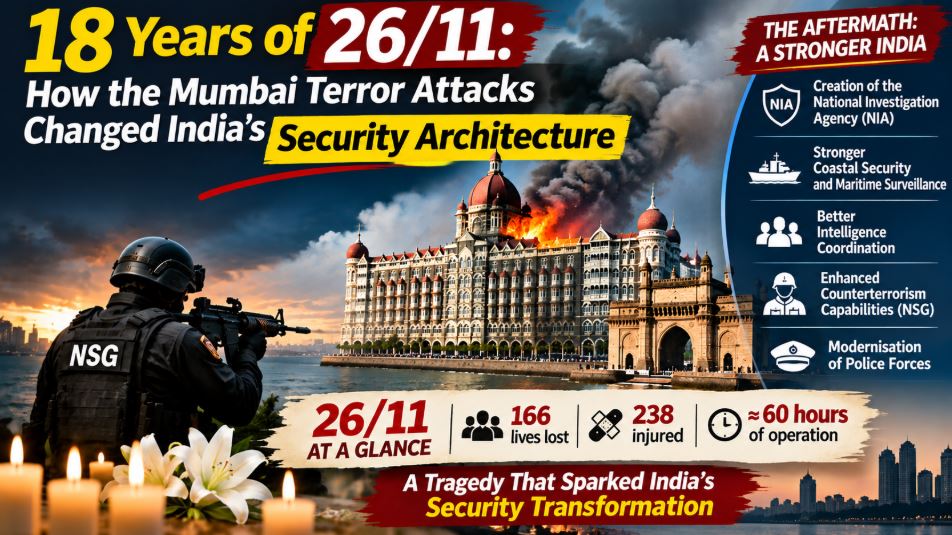
On the night of November 26, 2008, Mumbai witnessed an unprecedented assault that unfolded across multiple locations, leaving 166 people dead and hundreds injured. For nearly 60 hours, one of India’s most important financial and commercial centres remained under siege as heavily armed terrorists targeted public spaces, iconic hotels and establishments frequented by international visitors.
The attacks were not merely an act of violence against a city. They represented a direct challenge to India’s internal security framework, maritime surveillance capabilities and institutional preparedness to respond to coordinated terrorist threats.
Eighteen years later, the significance of 26/11 lies in two parallel narratives: the extraordinary courage of those who confronted the attackers and the institutional lessons India was compelled to learn from the tragedy. While the country continues to honour the victims and fallen heroes, the anniversary also raises an important question: how effectively has India transformed the painful lessons of 26/11 into a stronger and more resilient national security system?
26/11: A Coordinated Attack That Exposed India’s Vulnerabilities
The attacks began on the evening of November 26, 2008, when 10 heavily armed terrorists belonging to Pakistan-based Lashkar-e-Taiba (LeT) entered Mumbai by sea and launched coordinated assaults at several locations.
Chhatrapati Shivaji Maharaj Terminus (CSMT), the Taj Mahal Palace Hotel, the Oberoi-Trident Hotel, Nariman House, Leopold Café and Cama Hospital were among the principal targets.

Representational Image
The selection of these locations reflected a calculated strategy. The attackers targeted crowded public spaces, internationally recognised establishments and places associated with Mumbai’s economic and social life. The objective was not simply to inflict casualties but also to generate widespread fear, attract international attention and disrupt the normal functioning of the city.
The attacks exposed significant gaps in India’s ability to detect, prevent and respond to a complex, multi-location terrorist operation.
One of the most critical weaknesses was coastal security. The terrorists used the sea route to enter Mumbai, raising serious questions about maritime surveillance, intelligence coordination and the monitoring of India’s extensive coastline.
The simultaneous attacks also highlighted the challenges of responding to multiple emergencies across a densely populated metropolitan area. Local police personnel were among the first to confront heavily armed terrorists, often with limited equipment and inadequate information about the scale of the operation.
The nearly 60-hour-long confrontation demonstrated that counterterrorism preparedness requires more than armed personnel. It demands reliable intelligence, rapid communication, specialised equipment, clearly defined command structures and effective coordination between agencies.
The Human Cost: Remembering the Courage Behind the Tragedy
Beyond the strategic and institutional consequences, the most painful legacy of 26/11 remains the loss of innocent lives.
The attacks claimed 166 lives and left 238 people injured. Among those killed were ordinary citizens, foreign nationals, police officers and security personnel who confronted the terrorists to protect others.
Maharashtra Anti-Terrorism Squad chief Hemant Karkare, Additional Commissioner of Police Ashok Kamte and Senior Inspector Vijay Salaskar were among the prominent police officers who lost their lives.

Representational Image
Assistant Sub-Inspector Tukaram Omble displayed extraordinary courage while helping capture Ajmal Kasab alive, sacrificing his life in the process.
NSG commando Major Sandeep Unnikrishnan also became a national symbol of courage after losing his life during the counterterrorism operation at the Taj Mahal Palace Hotel.
Their sacrifices represented the human dimension of a tragedy that continues to shape India’s collective memory.
Hotel employees, railway personnel, emergency responders and ordinary citizens also displayed remarkable bravery during the crisis. Their actions demonstrated that resilience during a national emergency is not limited to the armed forces or police; it is also reflected in the courage of ordinary people.
The Security Turning Point: How 26/11 Reshaped India’s Counterterrorism Framework
Perhaps the most consequential impact of the Mumbai attacks was the recognition that India’s existing security arrangements required substantial structural improvements.
The attacks exposed weaknesses in intelligence-sharing mechanisms, maritime surveillance, police preparedness and inter-agency coordination. The response that followed marked an important shift towards strengthening India’s institutional capacity to investigate, prevent and respond to terrorism.

Representational Image
1. Establishment of the National Investigation Agency
One of the most significant institutional developments was the establishment of the National Investigation Agency (NIA) in December 2008.
The agency was created to investigate terrorism-related offences and other serious threats with national security implications. Its establishment reflected the need for a specialised investigative institution capable of handling cases that extend beyond state boundaries.
2. Strengthening Coastal Security
The sea route used by the attackers exposed a critical vulnerability in India’s maritime security framework.
In the aftermath, greater attention was given to coastal surveillance, maritime intelligence, coordination between security agencies and monitoring of vulnerable coastal areas.
The attacks demonstrated that national security cannot be confined to land borders. Protecting ports, coastal communities, fishing routes and maritime infrastructure is equally important.
3. Improving Intelligence Coordination
The Mumbai attacks highlighted the consequences of intelligence gaps and inadequate information-sharing between different agencies.
The subsequent security reforms placed greater emphasis on intelligence coordination, information exchange and the ability to identify emerging threats before they develop into major security emergencies.
The lesson was clear: intelligence is valuable only when it reaches the right authorities in time and translates into preventive action.
4. Expanding Specialised Counterterrorism Capabilities
The response to 26/11 also highlighted the importance of specialised forces capable of handling hostage situations, urban combat and coordinated terrorist attacks.
The National Security Guard strengthened its regional presence, while greater attention was directed towards improving the operational readiness of specialised counterterrorism units.
5. Strengthening Police Preparedness
The Mumbai Police were among the first responders during the attacks. However, the scale and intensity of the operation exposed the need for better equipment, specialised training, modern communication systems and stronger emergency response capabilities.
The experience reinforced the importance of preparing local police forces to handle terrorist incidents until specialised units can reach the affected locations.
Beyond Reforms: The Continuing Challenges of National Security
Although 26/11 triggered important institutional changes, security preparedness cannot be measured simply by the number of agencies established or equipment acquired.
The nature of terrorism continues to evolve. Modern security threats increasingly involve digital communication, online radicalisation, cyber vulnerabilities, financial networks and sophisticated methods of coordination.
This creates new challenges for intelligence agencies and law enforcement institutions.

Representational Image
For India, the central challenge is ensuring that intelligence inputs are converted into timely preventive measures. Stronger coordination between central and state agencies, continuous training, technological modernisation and effective crisis management remain essential.
Equally important is the need to strengthen urban security planning. Major cities contain critical infrastructure, transport networks, commercial establishments and densely populated public spaces. Protecting these areas requires coordinated planning between police forces, emergency services, local administrations and specialised security agencies.
Another important lesson from 26/11 is that national security must be treated as a continuous process rather than a response to individual crises. Preparedness requires regular assessments, realistic emergency exercises and the ability to adapt to changing threat patterns.
Eighteen Years Later: Remembering the Victims, Honouring the Heroes
As Mumbai observes the 18th anniversary of the attacks, tributes are being paid to the victims and security personnel who lost their lives.
Maharashtra Governor Jishnu Dev Varma and Chief Minister Devendra Fadnavis paid floral tributes to the fallen personnel at Mumbai Police headquarters. Deputy Chief Minister Sunetra Pawar and senior police officials also attended the commemorative programme and met the families of police personnel who made the supreme sacrifice.

Representational Image
External Affairs Minister S Jaishankar remembered the innocent victims and security personnel, reiterating India’s commitment to combating terrorism in all its forms and manifestations.
These commemorations are not merely ceremonial gestures. They represent the country’s collective responsibility to preserve the memory of those who lost their lives and recognise the sacrifices of those who stood against terrorism.
For the families of the victims, however, the tragedy is not confined to an anniversary. The absence of loved ones remains a permanent reality, making remembrance an enduring responsibility rather than an annual ritual.
Conclusion: 26/11 Must Remain a Lesson, Not Just a Memory
Eighteen years after the Mumbai terror attacks, the most important measure of India’s response to 26/11 is not simply how the country remembers the tragedy, but how seriously it continues to act on the lessons it left behind.
The attacks exposed vulnerabilities that could no longer be ignored. They demonstrated that intelligence failures, gaps in coordination and inadequate preparedness can have devastating consequences when a determined terrorist network exploits weaknesses in the security system. The institutional reforms that followed marked an important beginning, but national security is never a finished project.
As threats evolve, India’s response must evolve with them. Strong intelligence networks, secure maritime boundaries, modern policing, specialised counterterrorism capabilities and effective coordination between agencies must remain priorities. Equally important is accountability, because security institutions must continually assess whether their systems are capable of preventing the next crisis rather than merely responding to the previous one.
Above all, the story of 26/11 is not only about terrorism and destruction. It is also about courage, sacrifice and the extraordinary resilience of a city that refused to surrender to fear. The bravery of Hemant Karkare, Ashok Kamte, Vijay Salaskar, Tukaram Omble, Major Sandeep Unnikrishnan and countless others remains an enduring part of India’s national memory.
The true tribute to the 166 victims is not confined to floral wreaths, commemorative ceremonies or speeches. It lies in building a nation where intelligence is acted upon, institutions remain prepared, security failures are addressed and innocent lives are protected.
Eighteen years on, Mumbai remembers the night that changed its history. India must ensure that the lessons of that night continue to strengthen its future.