

Hyderabad, Sept 02: India has two enormous industries built around the same thing: emotion. One produces thousands of hours of stories watched on screens. The other produces millions of once-in-a-lifetime stories lived in real life. One builds film sets; the other builds wedding sets. One employs production designers, cinematographers, lighting crews, choreographers and costume specialists; the other increasingly employs exactly the same people.
Yet, despite this striking overlap, India’s wedding and film industries have largely operated as separate business ecosystems.There no business bridge between them. That could now be changing.
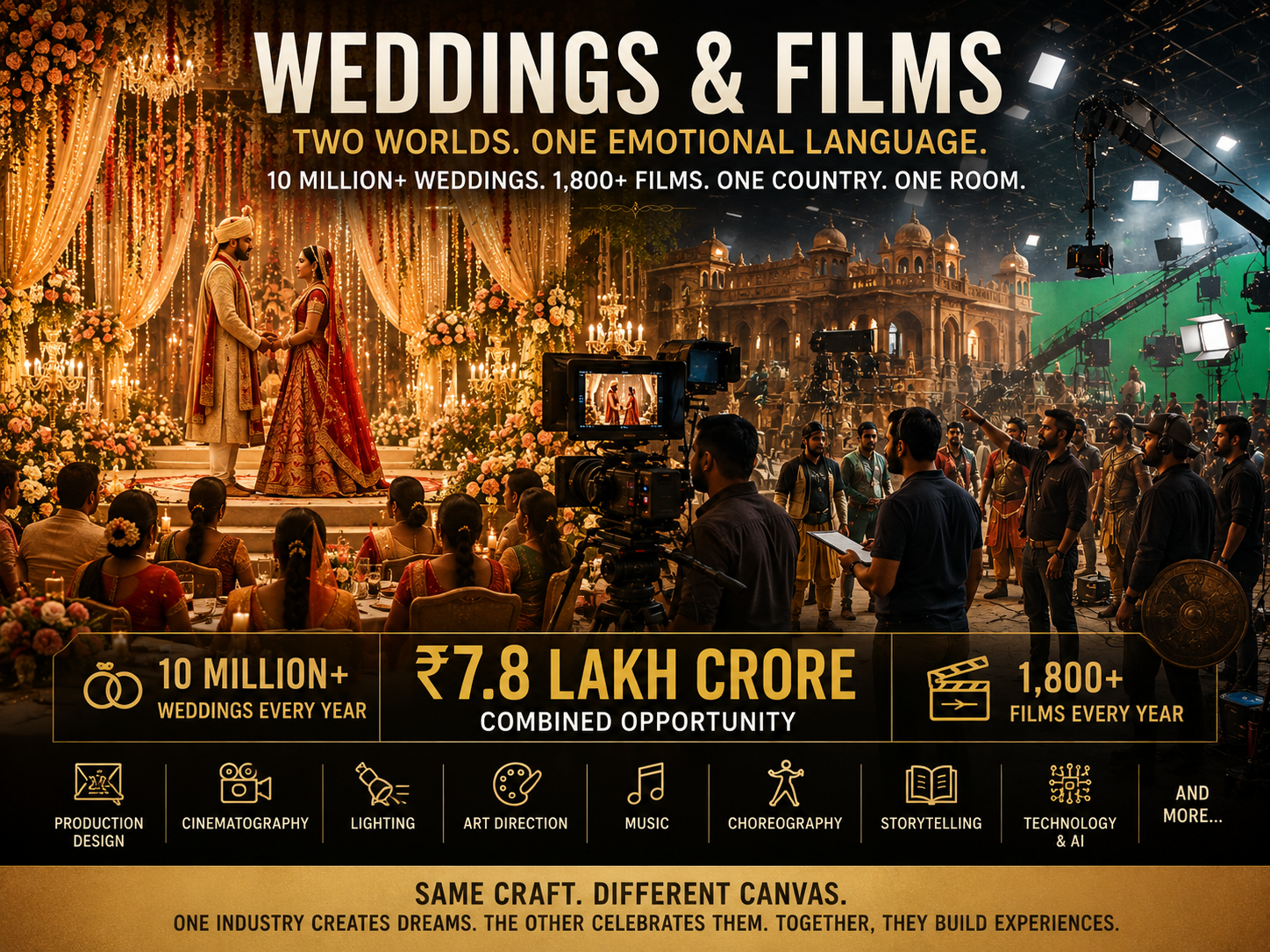
With an estimated one crore weddings taking place in India every year and around 1,800 films being produced annually, the scale of the two industries is extraordinary–Rs 7.8 lakh crore. India’s wedding market is estimated at around ₹3.86 lakh crore and growing at about 25% annually, while the country’s film and OTT ecosystem is estimated at around ₹1.97 lakh crore. Taken together, the two represent a massive creative and experience economy.
But there is a curious gap: there is no established formal B2B framework connecting the two industries at scale.
That is the business proposition behind WV Connect 2026, whose fourth edition, themed “Weddings & Films,” is bringing professionals from the two worlds together in Hyderabad. Same Craft. Different Canvas. The similarities are striking.
A modern luxury wedding increasingly looks like a film production. There is a creative brief, a narrative, a visual identity, production design, sets, lighting, costumes, music, choreography, cinematography, multiple technical crews and a final edited film.
The difference is the canvas. A film creates an imaginary world for millions of viewers. A wedding creates a real-world experience for a few hundred or a few thousand guests.
Both, however, live and die by the strength of their narrative. Both sell emotion. Both depend on spectacle. And increasingly, both use the same talent.
Production designers, art directors, cinematographers, lighting professionals, choreographers, costume designers, drone operators, photographers, editors, fabricators and digital creators frequently cross between film and weddings. What has been missing is not talent—it is a formal marketplace where that talent can discover new opportunities. From Film Sets to Wedding Sets The crossover is already visible.
Film production designers can bring cinematic scale to destination weddings. Wedding designers can borrow production techniques developed for cinema. Film locations and studios can explore a second life as wedding venues. Wedding venues can become locations for films, advertising and OTT productions.
Cinema’s visual vocabulary is also rapidly entering the wedding industry—projection mapping, immersive environments, virtual production, advanced lighting, drone cinematography, AI-generated experiences and cinematic storytelling are increasingly becoming part of luxury celebrations.
The result is a new question for both industries: What could they create together that neither could create alone? A New Market for Creative Talent. For film professionals, weddings could represent a significant additional market between productions. For wedding professionals, cinema offers access to production capabilities, technology and creative techniques that can elevate the guest experience. For technology companies, the intersection creates a new market for AI, AR/VR, projection, live streaming and immersive experiences. For hospitality and tourism, the opportunity is even broader—film locations becoming wedding destinations and wedding destinations becoming film locations. For MSMEs, the possibilities extend to fabrication, décor, floristry, lighting, furniture, costumes, printing, gifting, logistics and event production.
In other words, this is not simply about putting wedding planners and filmmakers in the same room. It is about connecting multiple layers of India’s experience economy.
And Then There Is OTT. One of the more intriguing opportunities lies in content.
Indian weddings are already becoming highly visual, highly produced storytelling experiences. Their characters, emotions, rituals, conflicts, fashion, food, destinations and family narratives provide an enormous reservoir of content. The wedding industry therefore has the potential to move from being merely a consumer of entertainment to becoming a source of entertainment content. That could create opportunities across documentary formats, wedding reality programming, digital series, branded content and social storytelling.
The question is whether wedding professionals are ready to think like content creators—and whether content platforms are ready to look at weddings as a new content ecosystem. The Destination Wedding–Film Location Crossover. Another largely unexplored opportunity is geography.
India has hundreds of spectacular wedding venues and destination properties. The film industry, meanwhile, is constantly searching for distinctive locations. What if a palace that hosts a wedding on Saturday becomes a film location on Monday? What if a film set designed for a period drama becomes an experiential wedding venue after the shoot? What if a destination markets itself simultaneously to film producers and wedding planners? WV Connect’s “Weddings & Films” theme puts precisely these possibilities on the table.
From 51 Wedding Minds to an Entire Ecosystem WV Connect has previously brought 51 of the world’s leading wedding professionals to its platform. Season 4 expands the conversation beyond traditional wedding businesses.
The ecosystem represented at the summit includes celebrity artists, artist managers, sound and lighting companies, florists, props and furniture suppliers, caterers, tourism boards, technology and AI companies, gifting companies, invitation designers, hospitality management companies, media and influencers, makeup artists, music and entertainment companies, luxury hoteliers, luxury travel companies, investors and consumer brands.
That diversity is important because the modern wedding is no longer a single-industry product. It is an ecosystem. The Lifestyle Story Behind the Business Story There is also a cultural reason this convergence matters. inema has influenced how Indians dress, dance, decorate homes and celebrate weddings for generations. Today, weddings are beginning to influence cinema and digital storytelling in return.
A wedding entry can resemble a film sequence. A wedding venue can resemble a movie set. Wedding films are increasingly produced like feature films. Couples are no longer simply hiring photographers; they are commissioning stories.
The boundaries between celebration, entertainment and content are disappearing. And that is perhaps the real story behind “Weddings & Films.” One Country. One Emotional Language. One Room.
India produces more films than any other country. It hosts one of the world’s largest wedding markets. Both industries employ enormous numbers of creative professionals. Both are increasingly technology-driven. Both are globalising.
Yet they have largely grown in parallel. 10 million-plus weddings. Around 1,800 films. One country. One emotional language. For the first time, WV Connect 2026 is attempting to put the people, businesses and ideas behind these two worlds in the same room. And that attempt is being made here in Hyderabad. It is a three day summit. WV Connect 2026 is Asia’s largest B2B Wedding Summit
The summit brings together an exceptional line-up of professionals who have shaped India’s visual and experiential landscape—including four-time National Award-winning production designer Sabu Cyril, acclaimed cinematographer K.K. Senthil Kumar, wedding and production design specialist Kumar Raja, and Wizcraft co-founder Sabbas Joseph for ‘Weddings & Films’ Edition. Their presence brings together the worlds of cinema, production design, cinematography, live entertainment and luxury weddings on one platform.800+ Wedding, Film, Hospitality and Creative Industry Leaders from 20+ Cities Converge for ‘Weddings & Films’ Edition. The three-day summit, being held at Arth Resorts from September 1 to 3, is themed “Weddings & Films”, exploring the growing convergence between two of India’s most creative and experience-driven industries
The opportunity may be bigger than the summit itself. It could be the beginning of a new segment of India’s creative, experience and entertainment economy—where the film set meets the wedding set, where the wedding becomes content, where the film location becomes a destination, and where creative talent moves freely between the two. The wedding industry has been producing spectacles. The film industry has been producing dreams. The next opportunity may be to build an economy around both.


Leave a Reply