

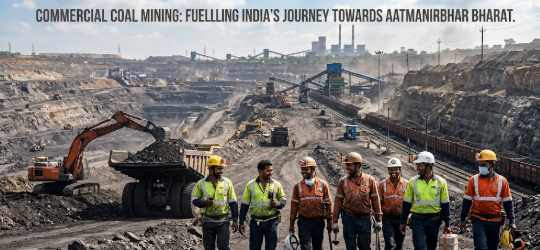
Representational Image
New Delhi, Aug 3: India’s commercial coal mining reforms are playing a key role in strengthening the country’s energy security, supporting industrial growth, and advancing the vision of Aatmanirbhar Bharat. With domestic coal production crossing the one-billion-tonne milestone for two consecutive years, the sector has emerged as an important pillar of India’s economic development.
Coal continues to remain a critical source of energy for the nation, meeting nearly 55 per cent of India’s primary energy requirements and supporting more than 70 per cent of electricity generation. India, which has the world’s fifth-largest coal reserves, is also the second-largest producer and consumer of coal globally.
Behind this large-scale energy network are around five lakh mine workers engaged across more than 350 mines, contributing to the country’s power supply, industrial activity, and economic progress.
Coal Production Reaches Historic Milestone
India’s coal production has witnessed remarkable growth over the past decade. Production increased from 609.18 million tonnes in FY 2014-15 to 1,047.52 million tonnes in FY 2024-25 and 1,040.08 million tonnes in FY 2025-26.
A major share of this growth has come from captive and commercial coal blocks, whose contribution to national coal production has increased significantly. These reforms have helped improve domestic availability of coal and reduce dependence on imported energy resources.
Commercial Mining Opens New Opportunities
A major transformation in the coal sector came with the launch of commercial coal mining in June 2020 under the Aatmanirbhar Bharat mission.
The reform allowed wider participation in coal mining by enabling companies to sell coal freely to consumers across sectors. It replaced the earlier restricted system with a transparent auction-based mechanism, encouraging competition, investment, and efficiency.
Since the launch of commercial coal auctions, 141 coal mines have been auctioned across 14 rounds, creating opportunities for both experienced companies and new entrants. Several private players, including companies entering coal mining for the first time, have participated in the sector.
Boost to Jobs, Investment and Local Development
The expansion of commercial coal mining is expected to generate significant economic benefits. Once fully operational, auctioned coal blocks are projected to bring:
- Around ₹47,000 crore in annual revenue
- Nearly ₹48,756 crore in investment
- Employment opportunities for approximately 4.75 lakh people
For communities living near mining areas, increased activity can bring new job opportunities, improved infrastructure, and greater economic development.
Supporting India’s Growth Story
A strong coal sector directly supports important industries such as power generation, steel, cement, and manufacturing. Reliable coal availability helps industries maintain production, supports infrastructure development, and contributes to economic stability.
The reforms have also increased government revenue, benefiting both the Centre and coal-producing states and supporting development initiatives.
A Step Towards Aatmanirbhar Bharat
The focus of commercial coal mining is not only on increasing production but also on building a transparent, competitive, and sustainable energy ecosystem.
By strengthening domestic coal production, encouraging investment, and creating employment opportunities, the reforms are helping India move towards greater energy independence.
The government’s continued efforts to simplify approvals and speed up mine operations aim to ensure that coal resources contribute more effectively to the country’s development.
Commercial coal mining today represents more than an industrial reform — it is a step towards securing India’s energy future, empowering communities, and building a stronger and self-reliant nation.

Leave a Reply