

New modules for yarn, fabric and garment finishing bring production data together under a unified methodology, offering an integrated view of a textile product’s environmental footprint.
The system uses real production data to generate traceable, structured information that supports Life Cycle Assessments (LCA) and Digital Product Passports (DPP).
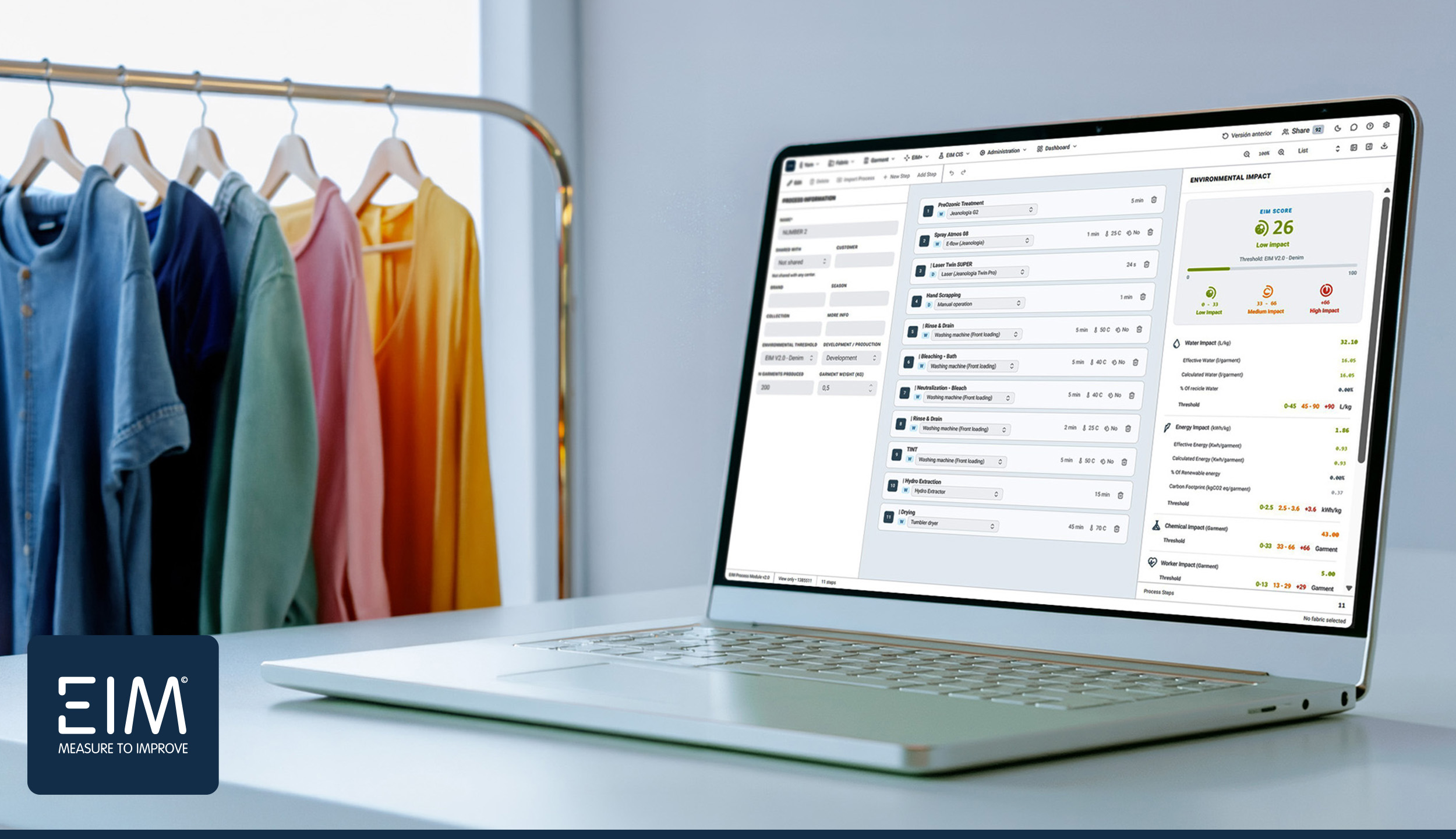
Valencia, October 1, 2026: Understanding the environmental impact of a garment remains one of the textile industry’s key challenges. From yarn production and fabric manufacturing to garment finishing, textile production involves multiple stages and stakeholders across the supply chain. Accessing reliable data from each process, connecting information and establishing a common methodology are essential to accurately assessing a product’s environmental footprint.
EIM (Environmental Impact Measuring), the global methodology developed by Jeanologia to measure the environmental impact of textile production processes, is entering a new phase of evolution. After more than 15 years of measuring the impact of garment finishing, EIM is expanding its scope to cover multiple stages of textile production under a unified methodology, connecting traceable and comparable data from yarn to finished garment.
This transformation marks the shift towards a new Environmental Intelligence approach, providing a comprehensive understanding of how a garment is produced and the environmental impact generated throughout its manufacturing journey, including water, energy and chemical consumption.
From Yarn to Finished Garment
To facilitate this expansion, the new EIM framework is structured around independent modules covering different stages of textile production.
The Yarn Module measures the environmental impact of yarn production, while the Fabric Module focuses on fabric manufacturing. The Garment Finishing Module continues to assess the environmental impact of garment finishing processes.
Each module can independently measure the impact of a specific production stage. Meanwhile, EIM+ integrates the results to provide a comprehensive view of the finished product.
This development significantly broadens EIM’s applicability, extending it beyond its historical association with denim and garment finishing to a methodology that can be applied to different types of textile products, from yarn to finished garments.
EIM evaluates environmental performance across water consumption, energy use and chemical consumption, while also assessing worker impact at the garment-finishing stage. Through a common methodology, the system classifies environmental performance into low, medium or high impact categories, making results easier to understand, compare and interpret.
Environmental Data That Travels with the Product
The evolution of EIM also enables information generated at different production stages to be connected while maintaining traceability.
Using primary data collected directly from manufacturing processes, EIM applies a consistent methodology to ensure that environmental information remains reliable and comparable across the production chain.
The resulting data is structured to support Life Cycle Assessments (LCA) and Digital Product Passports (DPP), enabling environmental information generated during manufacturing to remain connected to the product.
As demand for transparency, traceability and environmental disclosures continues to increase, EIM provides brands and manufacturers with easier access to reliable, structured information. This reduces the need to reconstruct a product’s environmental footprint from fragmented data scattered across different stages of the supply chain.
Developed by the Industry, for the Industry
“EIM was created more than 15 years ago to address a very specific industry need: measuring the environmental impact of garment finishing. Today, the challenge is much broader. We need to understand what lies behind the entire product, connect the different stages and enable the whole supply chain to speak the same language. This evolution towards Environmental Intelligence allows us to take that step, using measurement to understand, compare and keep improving,” said Begoña García, EIM Director.
EIM was developed by Jeanologia in 2009 and opened to the wider industry in 2011. Since then, the methodology has evolved alongside brands and manufacturers to become a global standard, currently used by more than 100 brands and 400 production facilities across over 50 countries.
More than 15 years after its inception, EIM is expanding beyond garment finishing to encompass different stages of production and a wider range of textile products. Developed by and for the industry, this evolution builds on the practical experience and real-world requirements of the brands and manufacturers using the methodology.


Leave a Reply