

New Delhi, Nov 23: India has announced a development cooperation package worth 24,000 crore Nepalese rupees for Nepal, focusing on post-flood reconstruction, long-term development and disaster resilience, as Prime Minister Narendra Modi and his Nepalese counterpart Balendra Shah agreed to deepen bilateral cooperation across infrastructure, energy, trade, education and cultural connectivity.
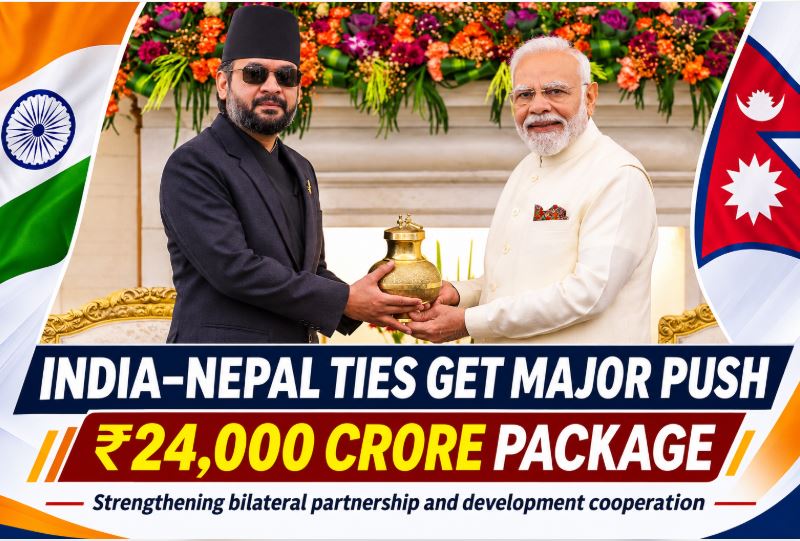
Representational Image
Making the announcement during a joint press statement in New Delhi on Monday, Modi welcomed Shah on his first bilateral visit to India after assuming office as Nepal’s Prime Minister.
Modi said India’s partnership with Nepal was rooted in mutual trust, shared history and close people-to-people ties. He added that the package would support affected families, create new opportunities and strengthen Nepal’s capacity to deal with future disasters following the devastating floods in August.
Rail and road links to strengthen people-to-people ties
Highlighting the shared religious and cultural heritage of the two countries, Modi said the newly launched Saryu-Kamala Express would provide a stronger connection between Ayodhya and Janakpur, making travel easier for pilgrims visiting the sacred sites associated with Lord Ram and Goddess Sita.
He also said India and Nepal would work together to improve connectivity between important Buddhist and religious destinations, including Lumbini and Bodh Gaya.
Infrastructure cooperation received further attention with the inauguration of the Dharchula road bridge between Uttarakhand and Nepal and the foundation stone laying for an Integrated Check Post at Banbasa. Work on the proposed Dodhara-Chandani Integrated Check Post on the Nepal side will also be expedited.
The two countries will accelerate road, railway and border connectivity projects linking Nepal with Bihar, Uttar Pradesh and other Indian states. India will also provide Nepal access to Kandla and Paradip ports to facilitate transit trade.
Energy partnership gets fresh momentum
Modi described Nepal’s river systems as a major source of clean energy and said India’s large energy market could help turn this potential into an engine of economic growth for Nepal.
The foundation stone for the Lower Arun Hydroelectric Project was laid, while India reiterated its commitment to completing the Arun-3 project on schedule.
Cooperation in the petroleum sector was also strengthened with the inauguration of Phase Two of the Motihari-Amlekhgunj pipeline and the foundation stone laying for the Jhapa Petroleum Terminal.
Modi said India had continued supplying fuel, fertilisers and other essential commodities to Nepal despite significant challenges in oil supplies during the year, reaffirming India’s role as a reliable partner.
Opportunities for Nepal’s youth and businesses
India will support the establishment of a start-up incubator, an innovation hub and an offshore campus of the Indian Institute of Technology in Nepal, according to the Prime Minister.
Scholarship opportunities for Nepalese students in law and technology in India will also be expanded. The two countries will collaborate in developing an agro-industrial park in Nepal to promote food processing and value addition.
Modi further announced plans to strengthen cooperation in sports, particularly cricket, through support for infrastructure development and player training in Nepal.
The cultural partnership will also extend to creative industries. India has invited a large Nepalese delegation to the next WAVES Summit, encouraging young creators from both countries to use films and modern technology to take their shared Ramayana heritage to global audiences.
Joint vision for shared prosperity
The two Prime Ministers also released a Joint Vision Document outlining a roadmap for closer cooperation, aligned with India’s vision of ‘Viksit Bharat’ and Nepal’s goal of a prosperous and developed nation.
Modi said the two countries had the shared objectives, mutual confidence and capacity required to turn their commitments into tangible outcomes.
Describing India and Nepal as partners connected by faith, culture and enduring friendship, he expressed confidence that the latest decisions would open a new chapter in bilateral relations.


Leave a Reply