

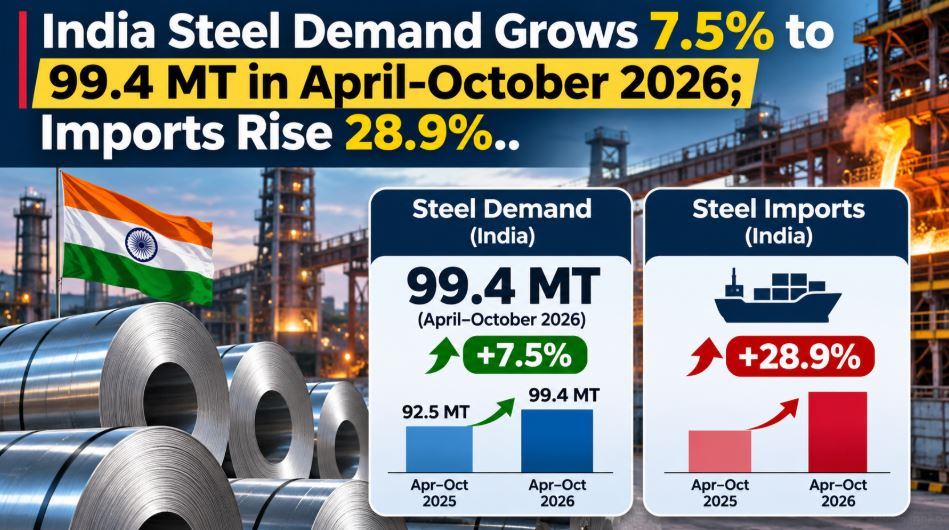
New Delhi, Nov 26: India’s steel demand remained robust during April-October 2026, with finished steel consumption rising 7.5 per cent year-on-year to 99.4 million tonnes (Mt), even as imports increased sharply and the country remained a net importer of finished steel.
Representational Image
Provisional data released by the Ministry of Steel show that domestic production also maintained an upward trend during the seven-month period. Finished steel output grew 4.1 per cent to 95.7 Mt, while crude steel production increased 2.6 per cent to 99.2 Mt compared with the corresponding period last year.
The figures point to sustained demand in the domestic market, supported by higher steel consumption, although the growing volume of imports highlights competitive pressures on Indian producers.
Production rises across major steel categories
India produced 14.5 Mt of crude steel in October 2026, up 3.6 per cent from 14 Mt in October 2025. Hot metal production increased 2.5 per cent to 8.3 Mt, while finished steel output rose 5.2 per cent to 13.8 Mt.
For April-October, hot metal production reached 56.8 Mt, marking a 2.7 per cent increase over the year-ago period.
The seven large steel producers — SAIL, RINL, NSL, TSL Group, AM/NS, JSL/JSPL and JSW Group — together accounted for 55.6 Mt of crude steel production during the period. The remaining producers contributed 43.6 Mt.
Imports climb as India remains a net buyer
Finished steel imports rose 28.9 per cent to 4.90 Mt during April-October, compared with 3.80 Mt in the same period last year. In value terms, imports increased 49 per cent to ₹52,493.7 crore.
Exports also grew, but at a slower pace. Outbound shipments rose 15.5 per cent to 3.98 Mt, valued at ₹32,177.2 crore, up 21 per cent year-on-year.
The country consequently remained a net importer of finished steel in volume terms during the seven-month period.
China was India’s largest source of finished steel imports, supplying 1.55 Mt or 31.6 per cent of total imports. South Korea followed closely with 1.52 Mt, accounting for 31.1 per cent. Japan, Indonesia and Vietnam were the other major suppliers.
On the export side, the UAE was the leading destination with 0.55 Mt, followed by Vietnam at 0.51 Mt and Italy at 0.36 Mt.
Hot-rolled coils and strips dominated both sides of trade, accounting for 35.3 per cent of imports and 38.6 per cent of exports.
Steel prices largely stable in November
Domestic steel prices showed limited month-on-month movement in November, following increases in October.
The average price of 10 mm TMT bars stood at ₹66,020 per tonne, down 0.9 per cent from October. Hot-rolled coil prices edged up 0.1 per cent to ₹77,703 per tonne, while cold-rolled coil prices declined 0.1 per cent to ₹86,890 per tonne. Galvanised plain sheet prices fell 0.5 per cent to ₹94,920 per tonne.
Despite the modest monthly changes, prices remained significantly higher than a year earlier. TMT prices were up 25.1 per cent, HR coil prices 36.4 per cent, CR coil prices 36.9 per cent and GP sheet prices 33.4 per cent year-on-year.
The averages are based on prices in Delhi, Mumbai, Kolkata and Chennai and include GST.
Alloy steel expands; stainless steel faces import surge
Alloy steel production recorded strong growth, rising 33 per cent to 6.91 Mt during April-October. Consumption increased 30.2 per cent to 7.50 Mt, while imports grew 13.2 per cent to 723,500 tonnes.
Stainless steel presented a contrasting picture. Production declined 4.6 per cent to 2.46 Mt, even as consumption rose 22.2 per cent to 3.19 Mt. Imports surged 143.3 per cent to over 1 Mt, while exports fell 14.9 per cent to 307,200 tonnes.
The sharp rise in stainless steel imports alongside lower domestic production and higher consumption marks a significant trend in the sector’s trade performance.
SAIL plants report production and operational milestones
The Ministry also highlighted operational achievements at major public-sector steel facilities.
At SAIL’s Bhilai Steel Plant, prime rail production through the Universal Rail Mill increased 147 per cent over eight years, from 369,000 tonnes to 911,000 tonnes. The prime rail acceptance rate improved from 85 per cent to 96 per cent.
Blast Furnace-8, known as Mahamaya, crossed 22 Mt of cumulative hot metal production on November 15, achieving the milestone in 3,208 days since commissioning.
SAIL’s Rourkela Steel Plant recorded its highest-ever April-October saleable steel production at 2.441 Mt in FY 2026-27, surpassing its previous record of 2.430 Mt set in 2023. Meanwhile, IISCO Steel Plant at Burnpur achieved more than 20,000 heats from a single converter lining, described by the Ministry as the highest such performance recorded in the Indian steel industry.
Green steel push gathers momentum
The Ministry said 112 distinct steel producers had received Green Steel Certificates under the certification lists issued up to October 2026. The certified product range includes TMT bars, hot- and cold-rolled coils, plates, wire rods and pipes, with a large majority receiving five-star ratings.
Separately, NMDC has set a target of achieving net-zero operational emissions by 2047, with a minimum 90 per cent emissions reduction through measures such as energy efficiency, renewable energy, fleet electrification, low-carbon fuels and carbon capture, utilisation and storage.
The Ministry’s latest review also covered the performance and ongoing initiatives of SAIL and NMDC, with a focus on production growth, capacity expansion, operational efficiency and major projects.
The data, compiled from provisional Joint Plant Committee figures for October 2026, indicate that India’s steel sector continues to benefit from strong domestic consumption. However, rising imports — particularly in stainless steel — remain an important factor shaping the industry’s competitive and trade outlook.

Leave a Reply