

New Delhi, Sep 15: India’s coal industry is entering a new phase as technology becomes an increasingly important part of how mines are explored, operated and monitored. For Coal India Ltd (CIL), the shift towards artificial intelligence, automation, digital monitoring and advanced mining equipment is aimed not only at increasing coal production but also at improving safety, cutting operational losses and building a more efficient supply chain.
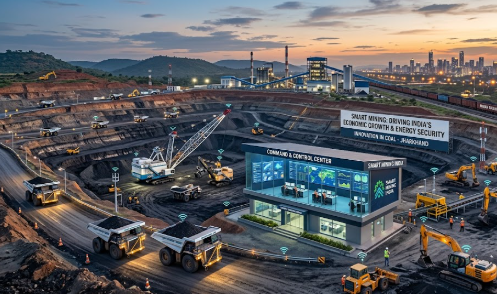
Mining has traditionally depended heavily on large equipment, manual supervision and conventional geological exploration. That model is gradually changing. Digital technologies are now helping mining companies collect more information, make faster decisions and monitor operations in real time.
Advanced drilling and 2D and 3D seismic surveys are improving the understanding of underground coal deposits. Remote sensing, GIS, LiDAR, drones and bathymetric surveys can provide additional information before, during and after mining activities.
Artificial intelligence is adding another layer to this process. Machine-learning systems can analyse geological information and help identify coal seams, allowing mining planners to make better decisions about where and how resources should be extracted.
For the coal industry, better resource mapping can have a direct economic benefit. More accurate information can reduce unnecessary exploration, improve recovery and help companies use existing resources more effectively.
Technology is also changing day-to-day mine operations. Internet of Things devices, GPS tracking, automated dispatch systems and payload monitoring can provide real-time information about vehicles and equipment.
Predictive maintenance is particularly valuable in large mining operations. Instead of waiting for a machine to fail, data from equipment can be analysed to identify early warning signs. This can reduce unexpected breakdowns, limit downtime and improve the productivity of expensive mining machinery.
Safety is another area where digital technology is making a visible difference. Mining involves heavy equipment, underground operations and other hazards. Systems that monitor operator fatigue, detect nearby vehicles, provide 360-degree visibility and identify fires automatically can reduce risks for workers.
The growing use of simulators and virtual reality can also improve training. Workers can practise handling difficult situations in a controlled environment before dealing with similar circumstances at an actual mine.
CIL is also looking at modern methods to increase underground coal production. Continuous Miners, Longwall and Highwall technologies can provide access to resources that may be difficult to recover through traditional methods.
The use of advanced underground systems could become increasingly important as the industry seeks to improve resource recovery while maintaining stronger safety standards. Investments in technologies such as Paste Fill can also help recover coal left behind in underground pillars.
Coal production, however, is only one part of the equation. Moving coal efficiently from mines to consumers is equally important. Investments in First Mile Connectivity and railway infrastructure are designed to reduce bottlenecks and make evacuation faster and more reliable.
Efficient transportation can benefit the entire industrial economy. Power plants need consistent fuel supplies, while steel, cement and aluminium producers depend on reliable energy and raw materials. Better coal logistics can therefore reduce supply disruptions and improve production planning for downstream industries.
The technology transition is also creating a new business opportunity for Indian companies. Mining operations increasingly require software, sensors, communication systems, drones, automation equipment and specialised engineering solutions.
This could give Indian startups and MSMEs more opportunities to become part of the mining technology supply chain. Companies capable of developing affordable and locally designed solutions could find demand not only within India but also in international mining markets.
Employment patterns in the sector are likely to evolve as well. While automation can reduce the need for people to perform certain hazardous or repetitive activities, the industry will require more skilled professionals in fields such as artificial intelligence, data analysis, robotics, electronics, automation and equipment maintenance.
Environmental management is another area where technology can make mining more responsible. Satellite imagery, drones, GIS and real-time monitoring systems can help companies track environmental conditions and identify potential problems more quickly.
CIL’s efforts to develop an AI-powered satellite-based geospatial monitoring system reflect the growing importance of data in environmental oversight. Technology can help mining companies monitor land use, environmental changes and rehabilitation activities more systematically.
The industry is also exploring electric mobility and other cleaner technologies. Electrifying mining equipment and using systems such as trolley-assist technology could reduce dependence on conventional fuel in certain operations while improving energy efficiency.
Inside mines, 5G networks, digital twins and autonomous monitoring systems could further change the way operations are managed. Digital replicas of mining environments can help engineers simulate situations, test operating plans and identify potential problems before they occur.
The economic significance of this transformation extends beyond Coal India. Coal continues to play an important role in India’s power and industrial sectors. Making domestic mining more productive can strengthen energy security and support industries that depend on reliable fuel supplies.
At the same time, investment in mining technology and infrastructure creates demand for engineering, manufacturing, software, logistics and construction companies. This can generate economic activity across multiple layers of the supply chain.
For India, the larger opportunity lies in combining the country’s mineral resources with its growing technology capabilities. A smarter mining industry can potentially deliver higher productivity while improving worker safety, operational efficiency and environmental monitoring.
The transition will require continued investment in technology, skilled manpower and digital infrastructure. But as artificial intelligence, automation, electrification and real-time monitoring become more common, technology is increasingly moving from the background to the centre of India’s coal industry.
The future of coal mining is therefore likely to be less about simply extracting more coal and more about extracting resources smarter, operating mines more safely and building a more efficient industrial ecosystem around them.


Leave a Reply