

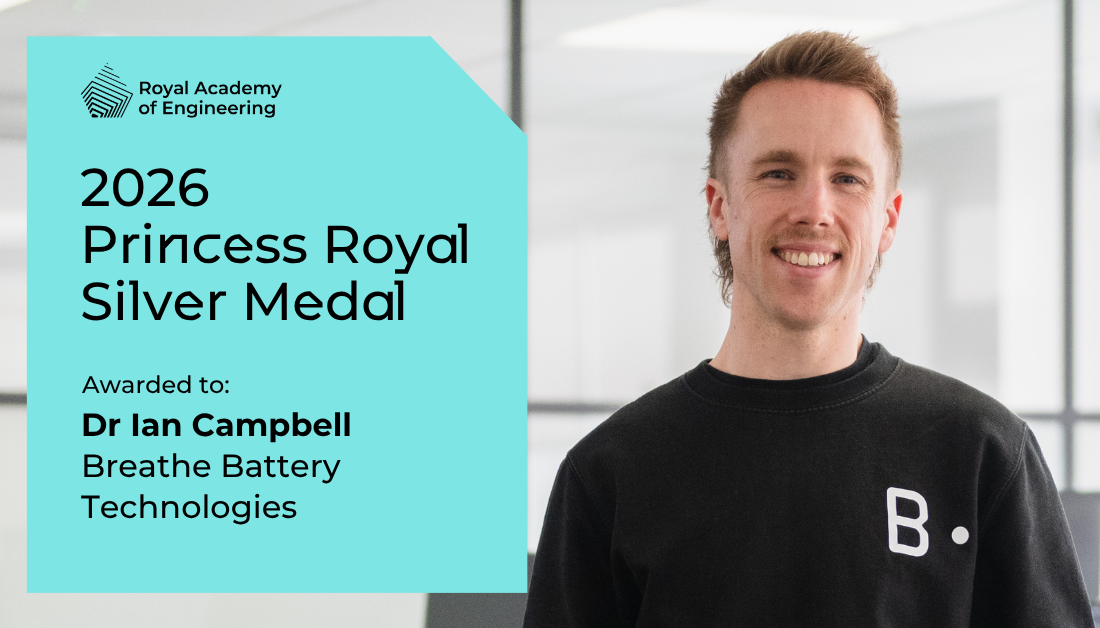
June 29: Three leading UK engineers are to be presented with The Princess Royal Silver Medal, one of the Royal Academy of Engineering’s most prestigious individual awards. They will receive their medals at the Academy Awards Dinner in London on Wednesday 8 July from HRH The Princess Royal, who is a Royal Fellow of the Academy.
The award celebrates an outstanding personal contribution made to UK engineering by an early to mid-career engineer resulting in market exploitation. This year’s winners have used lasers and optical fibres to develop a new way of capturing information from space, created software that makes batteries more sustainable, and applied AI to make touch-responsive materials.
The recipients of The Princess Royal Silver Medals for 2026 are:
· Dr Ian Campbell, Co-founder of Breathe Battery Technologies
· Dr Liucheng Guo, Co-founder and Chief Technical Officer of TG0
· Professor Robert Thomson FREng, Professor of Photonics at Heriot-Watt University
Luke Logan FREng, Chair of the Academy’s Awards Committee, said:
“This year’s winners of The Princess Royal Silver Medal have each pushed the boundaries of engineering. Through their research and innovative ideas, they have supported the UK in being a leader in engineering and sustainability, making significant contributions to our national economy through inspiring entrepreneurship and collaboration.”
Dr Ian Campbell, Co-Founder at Breathe Battery Technologies
With his company Breathe Battery Technologies, Ian has discovered how to extract the most potential from batteries by improving the charging process.
By simulating the internal workings of batteries, the team at Breathe created software that gives insight on the electrochemistry and other issues that can reduce their efficiency. The software helps manufacturers to optimise battery charging and design and can be integrated without hardware changes. By extracting better performance from existing battery chemistries, this technology has the potential to reduce electronic waste and accelerate the transition to cleaner, electrified transport and devices.
Ian achieved his PhD at Imperial College London with his research focus being lithium-ion batteries. Founded in 2019 as a spin-out from Imperial College London, Breathe Battery Technologies has now grown to operate the largest battery testing facility in London and has raised more than $33 million in funding. They have also collaborated with large corporations such as Volvo Cars, OPPO and Polestar.
Ian said:
“I am deeply honoured and humbled to receive the Princess Royal Silver Medal. Climate change and air pollution continue to threaten health and livelihoods worldwide. By combining battery physics simulation with materials libraries built in industrial-scale labs, we can screen millions of potential designs and rapidly optimise the most promising candidates using advanced software. This capability is helping to bring cleaner, quieter, healthier and more affordable cars, trucks and energy storage systems to market faster.”
Professor Ricardo Fernando Martinez-Botas, Head of the Department of Mechanical Engineering at Imperial College London, said:
“Ian’s success in commercialising world-class research from Imperial College London exemplifies how UK academic excellence can translate into real-world impact. His contributions are not only advancing the UK’s position at the forefront of the international battery technology race but helping to shape the future of cleaner transport.”
Dr Liucheng Guo, Co-founder and Chief Technical Officer of TG0
Dr Liucheng Guo, who received his PhD from Imperial College London, has spent the last decade developing a first-of-its-kind “AI for Sensing” technology for electronic products, giving machines a more human-like sense of touch and enabling more intuitive interaction.
Most electronic products, from robotic skins to car seats, rely on having individual buttons for powering on and off alongside multiple sensors and parts for general use. TG0’s patented technology replaces these complex separate parts with intelligent touch-sensitive surfaces powered by lightweight embedded AI, resulting in simpler, lower-cost and more sustainable designs. The system can detect signal changes from different components, for example, detection of pressure, location, direction and movement of touch. This mimics a more human way of perceiving and processing tactile information, creating more user-centric experiences.
The company has received support from Innovate UK, the European Innovation Council, and leading investors including Amadeus Capital Partners and Fuel Ventures. TG0 has been recognised as one of Deloitte UK’s Fast 50 fastest-growing technology companies, selected for Tech Nation’s Future Fifty programme, and received the GBx Best in British Tech Award for Deep Tech Innovation.
Liucheng is currently an Industrial Fellow of the Royal Academy of Engineering and a Fellow of both the Institution of Engineering and Technology (IET) and the British Computer Society (BCS). He was chosen to join the Academy’s Shott Scale Up Accelerator where he graduated as an SME Leader in 2019. He was also a Royal Academy of Engineering Visiting Professor in 2021 and is a STEM Ambassador, helping to inspire the next generation of engineers and innovators.
Liucheng said:
“I am deeply honoured to receive the Princess Royal Silver Medal. This recognition reflects not only my own journey, but also the dedication of my co-founder Ming, the TG0 team, investors, collaborators and mentors. I believe engineering has a vital role to play in shaping a resilient and sustainable future, creating technologies that are not only intelligent, but also accessible, energy-efficient and beneficial to society.”
Professor Wei Liu, Professor of Design Engineering and Innovation at King’s College London, said:
“Dr Guo’s pioneering approach to low-resource, sustainable embedded AI has immense potential for growth. His roadmap includes expanding in-material intelligence into medical wearables, adaptive robotics, and next-generation sustainable manufacturing – fields that will define the next decade of engineering innovation.
“He exemplifies the spirit of this award – engineering that transforms ideas into impact and inspires a more sustainable, intelligent world.”
Professor Robert Thomson FREng, Professor of Photonics at Heriot-Watt University
By applying photonics to astronomy, Robert invented the integrated photonic lantern, redefining what is possible in fibre optics.
Conventional optical fibres carry data as pulses of light. Across longer distances, these are typically single mode fibres that rely on light having a single pattern as it travels. Using single mode optical fibres to collect light in astronomy is challenging because most telescopes create signals inherently composed of multiple patterns. This leads to a loss of signal and increased noise.
To overcome this, Robert developed a new type of photonic lantern small enough to be mass produced and easily integrated into instruments for astronomy and other applications. Using ultrafast laser pulses, tiny 3D light-guiding paths are carved inside glass, creating pathways that smoothly connect the multimode light collection to single mode devices, preserving the information as it travels. Applications of Robert’s integrated photonic lanterns include capturing starlight to look for evidence of exoplanets, advanced medical and biological sensing, and next generation telecommunications.
Robert developed the first integrated photonic lanterns during his Advanced Fellowship funded by the Science and Technology Facilities Council, part of UKRI. He also co-founded a company called Optoscribe, which was later acquired by Intel.
Robert said:
“I am delighted to receive the Princess Royal Silver Medal. Throughout my career, I have been motivated by the challenge of translating fundamental discoveries into technologies that create tangible benefits for society. I have also been fortunate to work with outstanding students, researchers, clinicians and industrial partners, and this award reflects their contributions as much as my own.”
Professor Steve McLaughlin, Vice-Principal of Heriot-Watt University, said:
“Robert Thomson’s work in ultrafast laser microfabrication has redefined the art of the possible in photonics. His seminal inventions – the 3D waveguide interconnect and the integrated photonic lantern – are not only academic breakthroughs but transformative for industry.”

Leave a Reply