

For an entrepreneur, turning a business idea into a profitable enterprise requires more than a compelling product or a promising market opportunity. It demands capital, strategic planning, a capable team and the ability to make the right decisions at every stage of growth. While some businesses can expand through personal savings and revenue generated from operations, others need external investment to develop products, attract customers and establish a strong market presence.
This is where angel investors and venture capitalists play an important role. Both can help startups access the funds and expertise needed to grow, but their investment approaches, expectations and involvement in business decisions can differ considerably.
Choosing between them is therefore not simply a financial decision. It is a strategic choice that can influence a company’s ownership structure, operating flexibility, growth trajectory and long-term business direction.
Understanding the Difference Between Angel Investors and Venture Capitalists
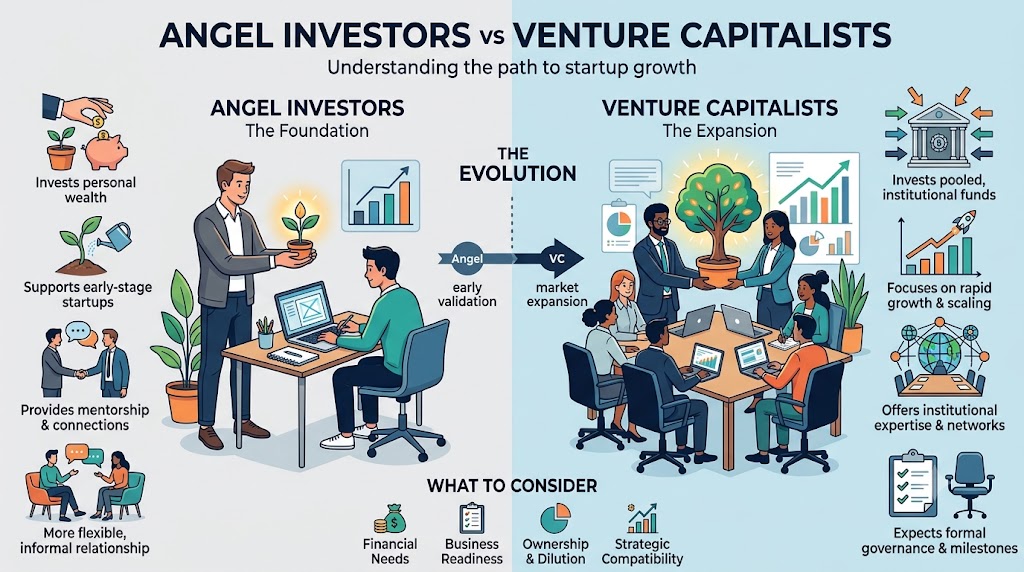
Angel investors are individuals who invest their personal wealth in startups, usually in exchange for an ownership stake. They often support businesses at an early stage, when founders are still developing a product, testing customer demand or building their first revenue streams.
For a new entrepreneur, this funding can provide the resources needed to move from an idea to a functioning business. The investment may help finance product development, market research, initial hiring, technology infrastructure or customer acquisition. In many cases, angel investors also contribute practical business knowledge and professional connections that founders may not yet have.
Venture capitalists, by contrast, invest through professionally managed funds that pool money from institutional investors, high-net-worth individuals and other sources. Their objective is generally to identify businesses with substantial growth potential and generate returns for the fund’s investors.
Although venture capital firms can support startups at the seed stage, they frequently look for evidence that a business has a viable product, a sizeable addressable market and the potential to expand rapidly. Their investments can help companies strengthen operations, enter new markets, recruit experienced leadership and build the infrastructure required for large-scale growth.
The fundamental difference lies in the nature of the capital and the investment approach. Angel investors commit their own money, while venture capitalists make investment decisions on behalf of a fund. Neither option is automatically better; the right choice depends on the business’s stage, funding requirements and ambitions.
Angel Investment: Building the Foundation for Growth
In the early days of a startup, uncertainty is often the biggest obstacle. Founders may have identified a customer problem and developed a promising solution, but they still need to establish whether the market is willing to pay for it.
At this stage, angel investment can provide a valuable financial bridge between an initial idea and a commercially viable business.
Consider an entrepreneur developing a digital platform for small retailers. Before expanding across multiple cities, the company may need to build its technology, test the platform with a limited group of users and demonstrate that retailers are willing to adopt it. An angel investor could provide the initial funding required to carry out these activities without forcing the business to pursue expansion before it is ready.
The benefits can extend beyond money. An angel investor with experience in retail, technology or distribution may introduce the founder to potential customers, help refine the business model and offer guidance on pricing, hiring and operational challenges.
Angel funding can also be useful for businesses that need a smaller initial investment and prefer a relatively straightforward fundraising process. However, the amount invested, speed of decision-making and degree of mentorship vary from one investor to another. Founders should evaluate the individual investor rather than assume that every angel offers the same advantages.
Venture Capital: Financing the Next Stage of Expansion
Once a startup has demonstrated market demand, its financial requirements can change significantly. Growing customer numbers may require more employees, stronger technology systems, additional working capital and a larger sales network. Expansion into new markets can also increase spending well before the additional revenue begins to arrive.
Venture capital can help businesses manage this transition.
For example, a consumer brand that has established a reliable customer base through online sales may want to expand its distribution network, enter new regions and invest in marketing. A venture capital investment could help finance these initiatives, provided the business demonstrates that its growth strategy is commercially credible.
VC firms can also bring institutional expertise, recruitment networks and connections to potential partners or future investors. Some provide substantial strategic support, helping businesses strengthen financial controls, improve operational efficiency and prepare for subsequent funding rounds.
However, this support comes with expectations. Venture capital firms generally assess a company’s growth potential, competitive position, financial performance and ability to generate attractive returns. Founders may be expected to meet agreed milestones, provide regular financial reports and participate in formal governance arrangements.
The decision to raise venture capital should therefore be driven by a clear business opportunity, not simply by the availability of a large investment.
Ownership, Control and the Cost of Capital
One of the most important considerations when raising equity funding is how much ownership a founder is prepared to exchange for capital.
Both angel investors and venture capitalists may receive equity in return for their investment. As a result, founders must consider not only the amount of money being raised but also the valuation at which the investment is made and the rights attached to the shares.
For instance, accepting a lower valuation can result in greater dilution, meaning the founder retains a smaller percentage of the company. Subsequent funding rounds may dilute ownership further. However, dilution is not necessarily harmful if the investment creates enough additional business value to make the founder’s remaining stake more valuable.
Control is another consideration. Some angel investors take a relatively informal role, while others request substantial influence over business decisions. Venture capital firms may seek board representation, voting rights or other protections designed to safeguard their investment.
Founders should examine these arrangements carefully. The objective is to secure funding without creating avoidable conflicts over strategy, spending, hiring or the future direction of the business.
A well-structured investment agreement should establish clear expectations for both parties and allow the company to pursue growth while maintaining appropriate accountability.
What Should Entrepreneurs Consider Before Choosing an Investor?
The first step is to identify the business’s immediate financial needs. A startup developing its first product may require money for experimentation and market validation, whereas a company with established sales may need substantial capital to increase production or expand distribution.
The second consideration is business readiness. Founders should assess whether they have a clearly defined customer base, a realistic revenue model, evidence of demand and a credible plan for using the investment. These factors can help determine whether an early-stage investor or an institutional fund is more appropriate.
Entrepreneurs should also examine the investor’s experience and expectations. Industry knowledge, useful connections and a willingness to support the company through difficult periods can be as valuable as the investment itself. At the same time, founders should understand the investor’s preferred time horizon and expectations for returns.
Finally, the cost of raising funds must be considered in relation to the company’s long-term plans. External investment can accelerate growth, but it does not replace sound financial management. Businesses still need to monitor cash flow, control expenses, retain customers and build a sustainable path towards profitability.
A Staged Approach Can Strengthen a Startup’s Position
Angel investment and venture capital do not have to be competing alternatives. For many startups, they represent different stages in a broader funding strategy.
A founder may initially raise money from an angel investor to develop a product, test the market and establish early sales. Once the business has gathered evidence of customer demand and demonstrated that its model can be scaled, it may approach venture capital firms for a larger round of financing.
This progression can help founders make more informed decisions about expansion. Instead of raising substantial funds before the business model is proven, they can use early capital to reduce uncertainty and build a stronger case for future investment.
Nevertheless, the approach must suit the business. Some companies can grow sustainably through customer revenue, loans or other financing options and may not need to surrender equity at all.
Funding Should Serve the Business, Not Define It
The success of a startup depends on much more than the identity of its investors. Product quality, customer trust, market timing, financial discipline and execution remain central to long-term performance.
Angel investors can be valuable partners for entrepreneurs seeking early capital and practical guidance. Venture capitalists can help businesses with strong growth potential access larger amounts of funding and institutional support. Both, however, require careful evaluation of investment terms, expectations and strategic compatibility.
For founders, the most effective fundraising decision is one that addresses the company’s actual needs, protects its long-term interests and creates a realistic path towards sustainable growth.
Ultimately, the goal is not to raise the largest possible amount of money. It is to build a business in which the capital raised translates into stronger capabilities, satisfied customers, reliable revenue and lasting commercial value.


Leave a Reply