

Leadership in the AI Age: Psychological Insights for Teaching, Learning & Well-being | 23–27 November 2026 | Online
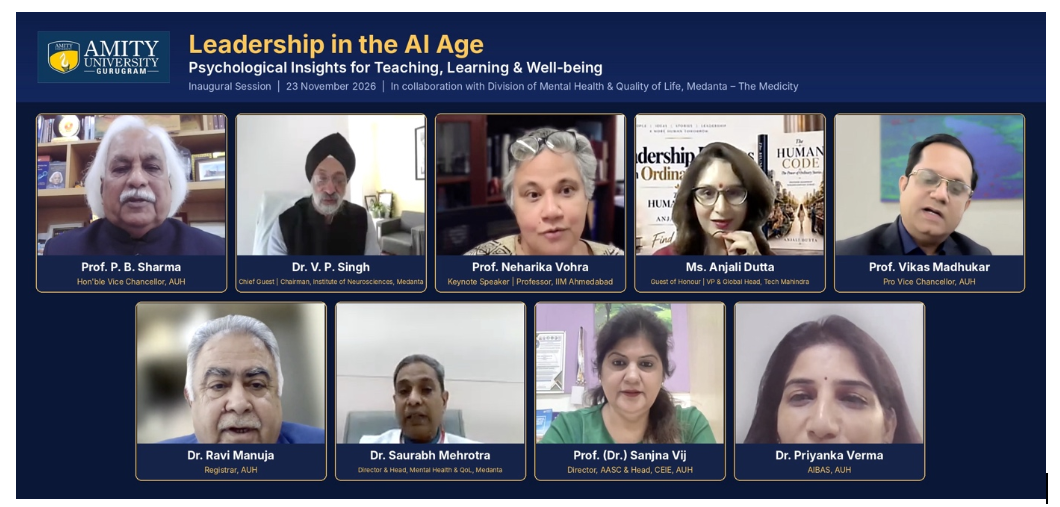
Gurugram, Nov 25: Amity University Haryana inaugurated its 5-Day Online Interdisciplinary Leadership Development Programme, “Leadership in the AI Age: Psychological Insights for Teaching, Learning & Well-being”, on 23 November 2026.
The programme is jointly organised by the Amity Academic Staff College (AASC), the Centre of Excellence for Innovation in Education (CEIE), the Amity Institute of Behavioural & Allied Sciences (AIBAS) and the Amity Institute of Clinical Psychology (AICP) in collaboration with the Division of Mental Health & Quality of Life, Medanta – The Medicity, Gurugram, as knowledge partner.
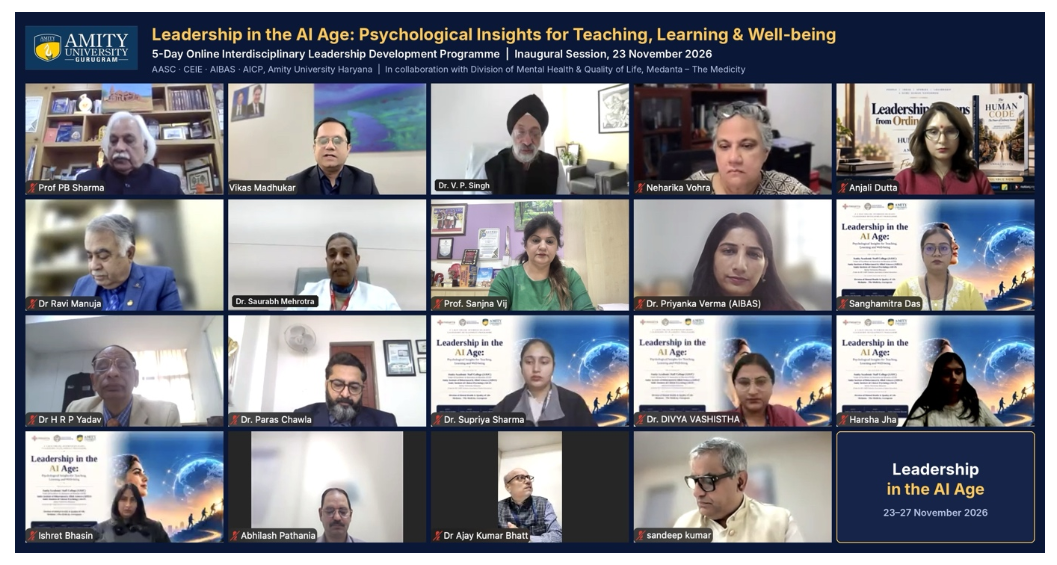
More than 70 participants joined from universities and organisations across India, including Amity University Rajasthan, Career Point University, Gurugram University, Chanakya University, University College of Medical Sciences (University of Delhi), VIT Vellore, Tripura University, MIT World Peace University, NCERT, IILM University, NIILM University, St. Joseph’s University and Dev Sanskriti Vishwavidyalaya.
The session began with a virtual lamp lighting and Saraswati Vandana, followed by a short video introducing the program.
In his presidential address, Prof. P. B. Sharma, Hon’ble Vice Chancellor, Amity University Haryana, said that AI has increased our appetite for learning, but is also affecting our mental well-being and making us more dependent on technology. Prof Sharma reminded the audience that learning is not only about learning to know, but also about “learning to live together in peace and harmony, and learning to live a cheerful, happy and healthy life.”
He gave teachers a simple piece of advice: begin every class by making students cheerful. “Once you have made everybody cheerful and smiling, they will be connected to you,” he said. Responding to the keynote, he added: “Our major challenge today is how we remain the master of our mind, rather than AI taking over.”
Prof. Vikas Madhukar, Pro Vice Chancellor, Amity University Haryana, said that we have moved from the information age to the “intelligence age”, and that AI has reached the masses faster than the internet or smartphones. The key question, he said, is how to build an ecosystem where AI amplifies human ability, “not one where AI takes the driver’s seat and humans sit in the passenger seat.” He shared how the University uses AI in admissions, curriculum design and teaching, learning and assessment. Under its Mission AI for All, launched with Google India, AI courses are now compulsory for students across all programmes, including non-STEM subjects. A course on Responsible Use of AI and Digital Citizenship has also been introduced. He noted faculty concerns about “technostress” and warned that cognitive offloading (handing our thinking over to AI) can weaken students’ critical thinking, creativity and problem-solving.
In her keynote address, Prof. Neharika Vohra, Professor of Organisational Behaviour, IIM Ahmedabad, said that AI touches the very identity of teachers, since it can now explain, organise and check learning faster. She urged institutions to create psychological safety for faculty, who are at different stages of the AI journey, so that colleagues can share what they learn openly, without judging each other. She also suggested that departments sit together and discuss which parts of the teacher’s role AI helps with, which parts must change, and which parts now gain more meaning. Prof. Vohra shared a colour-coded approach in which course material is marked for no AI use, guided AI use or free AI use, so that students first build the foundation they need to judge AI output. She asked teachers to use the time saved by AI for human connection: if AI turns an hour’s task into five minutes, “what do I do with those 55 minutes?” She urged them to spend that time connecting with students and colleagues. She also reminded everyone of AI’s limits: it is built on past data and can repeat old biases, and much human knowledge, such as a healer’s knowledge of medicinal trees in Bastar, is not found in any textbook.
“Intelligence gets created at the edge of an encounter: with a problem, with nature, with another person,” she said. She ended by encouraging every teacher to try small experiments in their own courses over the next few weeks.
Ms. Anjali Dutta, VP and Global Head, Digital Experience, Tech Mahindra, gave an interactive talk built on everyday stories. Comparing a modern digital lock with the traditional chitkani, she noted that the old latch works because its mechanism is open and easy to understand, while smart technology often lacks transparency and leaves no workaround. Through memories of learning to ride a bicycle, of power cuts that brought neighbours together, and of Hamam soap and Parle-G, she showed that real understanding comes from lived experience.
“Shortcuts can deliver answers; learning builds understanding,” she said. She asked teachers to help students question, explore, experience and understand, and to go to the ground before turning to AI. Sharing her book Human Code, she said: “We need to be human first.”
The Chief Guest, Dr. V. P. Singh, Chairman, Institute of Neurosciences, Medanta – The Medicity, Gurugram, addressed the gathering and stated that “As machines become increasingly intelligent, how do we ensure that human beings become increasingly wise?” he asked.
Dr Singh said education must now develop judgement, critical thinking, curiosity and ethical reasoning, and must teach students “not merely what to think, but how to think.” On the teacher’s role, he said: “A machine may explain a concept, but a teacher can recognise the hesitation in the eyes of a student.” He called for human-centred leaders who combine technological skill with emotional intelligence and empathy, and for institutions that protect well-being. “The real measure of our progress in the AI age will not be how intelligent our machines become, but how thoughtfully, ethically and humanely we choose to use them.”
Welcoming the gathering, Prof. (Dr.) Sanjna Vij, Professor and Director, Amity Academic Staff College and Head, Centre of Excellence for Innovation in Education, began with a simple question: in a world where AI can do so much for us, what will still make us good leaders? Her answer was our ability to understand people, listen to them, connect with them and make the right decisions. “AI can make us faster, but only people can make us wiser,” she said. She added that working faster does not always mean deciding better, and that wisdom comes from experience, values and understanding people. She thanked Dr. Saurabh Mehrotra for bringing the Medanta collaboration together.
Dr. Priyanka Verma, HOD, AIBAS, said that when knowledge is available at the click of a button, education must shift “from information to imagination, and from intelligence to wisdom.” She added that AI can calculate in a fraction of a second, but cannot recognise the silent anxiety in a student’s eyes. “The future does not belong to the masters of AI. It belongs to those who can master the art of well-being, being human, and becoming more empathetic and compassionate.”
Dr. Ravi Manuja, Registrar, Amity University Haryana, proposed the vote of thanks. He thanked the Founder President, Dr. Ashok K. Chauhan, and the Chancellor, Dr. Aseem Chauhan, for their vision, along with all the dignitaries, speakers, organisers and participants. He closed with the thought that “a true leader is known not by the number of followers, but by the number of leaders produced and inspired.”
The inaugural session was followed by the first technical session, led by Dr. Saurabh Mehrotra, Director and Head, Division of Mental Health & Quality of Life, Medanta – The Medicity, Gurugram.
Over the next four days, experts in psychology, psychiatry and education will lead sessions on the psychology of AI and human behaviour; emotional intelligence, resilience and well-being; psychology, AI and teaching-learning; and turning psychological insight into leadership action.

Leave a Reply