

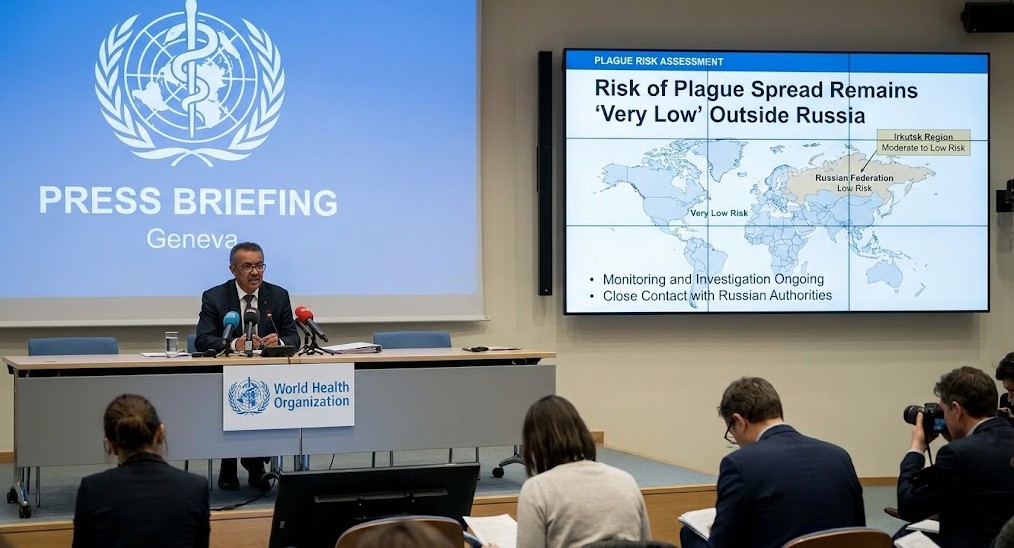
United Nations, Oct 8: The World Health Organization (WHO) has assessed the risk of the plague spreading beyond a suspected incident in Russia as “very low”, even as international concern grows over the death of a technician linked to a plague research facility in Siberia.
Representational Image
WHO spokesperson Christian Lindmeier said Tuesday that authorities had identified and were monitoring people who had been in contact with the deceased woman. So far, none of the contacts has developed symptoms associated with plague.
“According to the test results, no pathogens of dangerous infectious diseases were detected among any of the contacts,” Lindmeier told reporters in Geneva.
The WHO currently assesses the risk as moderate to low in Irkutsk, where the incident occurred, low for Russia as a whole, and very low for the WHO European Region, Lindmeier said.
The technician, who worked at a research institute studying dangerous pathogens, reportedly died last week after developing pneumonia. Russian authorities said her illness initially appeared to be a typical acute respiratory viral infection.
Media reports have suggested that she may have fallen ill after accidentally breaking a test tube at the facility last month. However, the circumstances surrounding her illness and death remain under investigation.
The research institute is located in Siberia, a region where plague occurs naturally among wild animals. The WHO said it contacted Russian authorities after reports of the death emerged and is continuing to monitor developments.
US Watching Situation Closely
The incident has also drawn attention in Washington. US Secretary of State Marco Rubio said the United States was monitoring the situation “very closely, hour by hour”.
Rubio said there could be nothing unusual about the incident but acknowledged that it remained unclear whether the situation was more serious than initially believed. He also called on Moscow to share further information with the international community.
The heightened concern comes against the backdrop of continuing debate over the origins of the COVID-19 pandemic and the possibility of laboratory-related incidents involving dangerous pathogens.
Russian authorities, meanwhile, have sought to reassure the public. Kremlin spokesman Dmitry Peskov said the country’s health watchdog, Rospotrebnadzor, was closely monitoring the situation and urged people not to rely on rumours or speculation.
What Is Plague?
Plague is an infectious disease caused by the bacterium Yersinia pestis, which is primarily found in small mammals and their fleas. Humans can become infected through flea bites or direct contact with infected tissues. Pneumonic plague can also spread through respiratory droplets from an infected person or animal.
The most common form, bubonic plague, causes painful swelling of the lymph nodes, known as buboes. More severe forms include septicaemic plague, which affects the bloodstream, and pneumonic plague, which affects the lungs.
Despite the concerns surrounding the Russian incident, the WHO’s current assessment indicates that the risk of wider international transmission remains very low.


Leave a Reply