

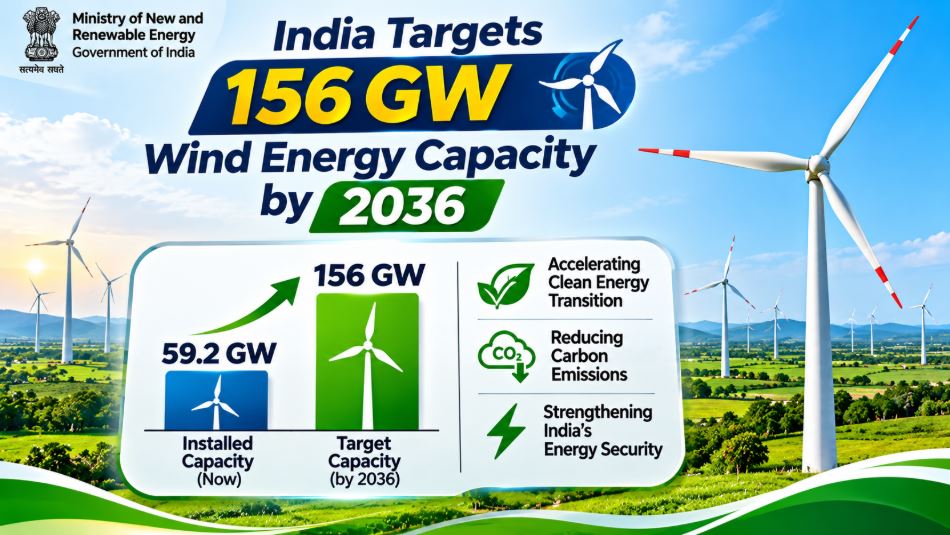
New Delhi, Nov 18: India is stepping up its wind energy ambitions, targeting 156 GW of installed capacity by 2036 as it accelerates the transition towards clean electricity and strengthens its energy security. With installed wind power capacity reaching 59.20 GW as of September 30, 2026, the country is emerging as a major global player in renewable energy development.
Representational Image
According to a backgrounder released by the Press Information Bureau (PIB), wind power currently accounts for approximately 19.8 per cent of India’s total installed renewable energy capacity of 299.25 GW. The sector has witnessed significant expansion over the past decade, with installed capacity rising from 21 GW in March 2014 to 59.20 GW in September 2026, representing nearly 2.8 times growth.
India’s wind energy expansion is being supported by strong natural resources, growing domestic manufacturing capabilities, policy interventions and increasing investment in renewable power infrastructure.
India has massive untapped wind energy potential
The country possesses considerable wind energy resources that could support its long-term renewable energy ambitions.
Estimates indicate that India’s gross wind power potential stands at 695.5 GW at a height of 120 metres and rises to 1,163.9 GW at 150 metres above ground level.
Eight states account for a significant share of this potential. Rajasthan leads with 284.2 GW, followed by Gujarat at 180.8 GW, Maharashtra at 173.9 GW and Karnataka at 169.3 GW.
Andhra Pradesh has an estimated potential of 123.3 GW, while Tamil Nadu accounts for 95.1 GW. Madhya Pradesh and Telangana have estimated potentials of 55.4 GW and 54.7 GW, respectively.
To identify suitable locations for wind power development, the National Institute of Wind Energy (NIWE) has established more than 90 wind-monitoring stations across the country. Wind resource maps have also been prepared at different hub heights ranging from 50 metres to 150 metres.
This resource base provides an important foundation for India’s target of achieving 100 GW of wind power capacity by 2030 and 156 GW by 2036.
Record capacity addition strengthens India’s global position
India currently ranks fourth globally in installed wind power capacity, reflecting the rapid development of its renewable energy sector.
The country recorded its highest-ever annual wind capacity addition of 6.05 GW during the financial year 2025-26, surpassing the previous record of 5.4 GW achieved in 2016-17.
A further 28 GW of wind power capacity is currently under implementation, indicating a substantial pipeline of upcoming projects.
Wind power is also becoming increasingly important for balancing electricity demand. Nearly 45 per cent of wind electricity generation takes place during peak demand hours, complementing solar power and supporting greater stability in the electricity grid.
India generated 106.7 billion units of wind electricity during FY 2025-26, highlighting the sector’s growing contribution to the national power supply.
Domestic manufacturing emerges as a major growth driver
Alongside capacity expansion, India is strengthening its position as a manufacturing hub for wind energy equipment.
The country’s wind turbine manufacturing capacity has increased from around 10 GW in 2014 to approximately 24 GW as of March 2026.
Domestic manufacturing now accounts for 70-80 per cent indigenisation across key components of wind turbines. Indian supply chains have developed capabilities in manufacturing blades, towers, gearboxes and other critical equipment.
The expansion of domestic manufacturing is expected to support project development, reduce import dependence and create opportunities for investment and employment across the renewable energy value chain.
Government initiatives to accelerate wind power development
The Centre has introduced several policy measures and financial incentives to encourage wind energy investments, including offshore wind development and improved grid integration.
A major initiative is the approval of Rs 6,853 crore in Viability Gap Funding (VGF) for 1,000 MW of offshore wind projects, comprising 500 MW each off the coasts of Gujarat and Tamil Nadu.
A 500 MW pilot project has also been launched under the Contracts for Difference (CfD) mechanism, which is designed to reduce electricity price volatility and provide greater revenue certainty to renewable energy developers.
Other measures include dedicated wind components under Renewable Purchase Obligations (RPOs), Green Energy Open Access Rules and the implementation of the Approved List of Models and Manufacturers (ALMM).
The government is also promoting hybrid renewable energy and Round-the-Clock (RTC) power projects to improve the reliability and integration of renewable electricity into the national grid.
A task force constituted in January 2026 is working to address regulatory, land acquisition, transmission and project implementation challenges affecting the wind energy sector.
Offshore wind and international partnerships gain momentum
India is increasingly looking towards offshore wind power as an important source of future renewable electricity generation.
Cooperation with countries such as the United Kingdom, Denmark, Belgium and Germany is helping India explore advanced technologies, financing models, infrastructure development and regulatory frameworks for offshore wind projects.
Under Vision 2035 and the Fourth India-UK Energy Dialogue, the India-United Kingdom Offshore Wind Taskforce was launched in February 2026. Its focus areas include market design, port infrastructure, supply chains and blended finance.
India and Belgium have also reaffirmed cooperation in offshore wind, research and development and green taxonomy during the World Economic Forum 2026.
India’s partnership with Denmark, established through a cooperation agreement in 2019 and renewed in May 2025, covers offshore wind capacity building, power system modelling, renewable energy integration and technical training.
These international collaborations are expected to facilitate knowledge sharing and support the development of India’s emerging offshore wind industry.
Odisha and other emerging states in focus
As established wind-producing states continue to expand their capacity, the government is also looking towards emerging regions to diversify wind energy development.
Madhya Pradesh, Telangana and Odisha have been identified among the states where wind power deployment could be expanded.
The next phase of development will also focus on modernising electricity transmission infrastructure, integrating energy storage, improving forecasting through artificial intelligence and strengthening domestic manufacturing.
Wind power to shape India’s clean energy future
India’s ambition to reach 156 GW of wind energy capacity by 2036 reflects the growing importance of renewable electricity in its long-term development strategy.
However, achieving this target will require faster project execution, improved grid connectivity, stronger financing mechanisms and wider adoption of advanced technologies.
With substantial untapped wind resources, expanding manufacturing capabilities and growing international cooperation, wind power is positioned to play a critical role in India’s efforts to reduce dependence on fossil fuels, improve energy security and build a more sustainable electricity system.
The coming decade will be crucial in transforming India’s considerable wind energy potential into operational capacity and establishing the country as a leading force in the global renewable energy transition.


Leave a Reply