

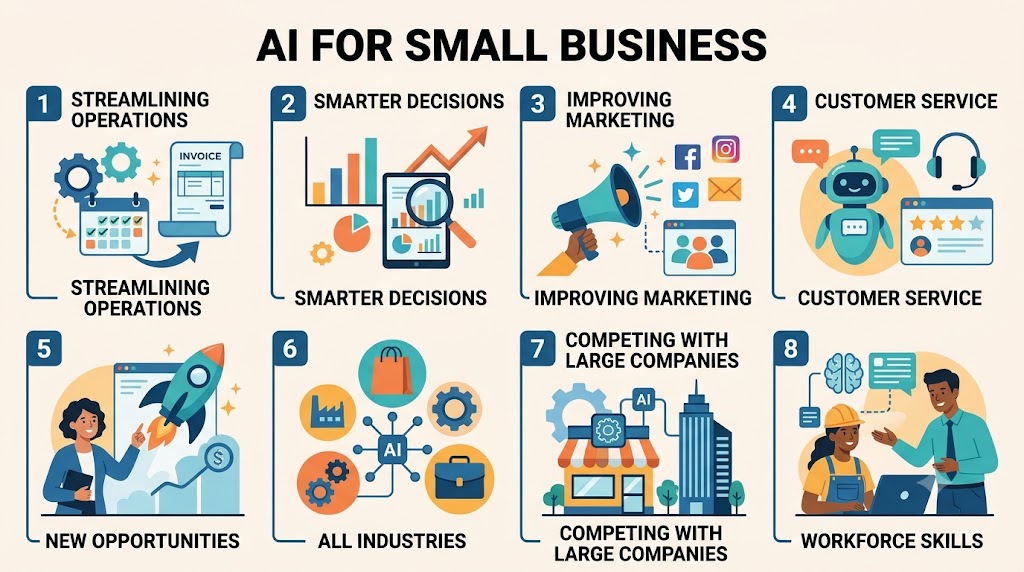
Artificial intelligence is changing the way small businesses operate, compete and expand. Tasks that once required specialised employees, expensive software and considerable time can now be managed more efficiently with accessible AI-powered tools. From handling customer enquiries and analysing sales data to improving marketing and streamlining daily operations, AI is giving smaller companies access to capabilities that were previously available mainly to large enterprises.
For small businesses, this shift represents more than a technological development. It offers an opportunity to improve productivity, control operating expenses and discover new sources of revenue. In an increasingly competitive business environment, entrepreneurs must find ways to do more with limited resources while continuing to deliver quality products and services. AI is helping make that possible.
The growing adoption of artificial intelligence also signals a change in how businesses approach growth. Rather than depending entirely on larger teams or increased investment, small companies can use technology to strengthen their operations, understand customers and make more informed decisions. The real opportunity lies in using AI to solve everyday business problems and turn those improvements into measurable commercial results.
Why AI Adoption Is Becoming Important for Small Businesses
Small businesses often operate with limited budgets, smaller teams and fewer specialised resources. Owners may be responsible for managing sales, marketing, customer service, financial records and daily administration at the same time. These responsibilities can leave little room for strategic planning or expansion.
AI is helping businesses manage this pressure by automating repetitive activities, organising information and supporting routine decision-making. It can reduce the time spent on administrative work and allow employees to focus on activities that directly contribute to business performance.
Another important advantage is accessibility. Businesses no longer need to develop complex technology systems independently to benefit from artificial intelligence. Many AI-powered services are available through affordable software platforms, making it easier for smaller companies to explore automation and digital transformation.
For entrepreneurs, AI adoption is becoming a practical way to improve efficiency, strengthen competitiveness and prepare their businesses for changing market conditions.
1. Streamlining Operations and Reducing Business Costs
Managing everyday operations can be time-consuming, particularly for businesses with limited staff. Activities such as email management, appointment scheduling, invoice processing, inventory monitoring and document preparation often take attention away from more important responsibilities.
AI-powered automation can simplify many of these processes. Businesses can organise routine enquiries, manage bookings, prepare reports and monitor stock movements with less manual effort.
In retail, intelligent inventory systems can help identify purchasing patterns and highlight products that may require replenishment. In service businesses, automated scheduling and communication can improve appointment management and reduce administrative delays.
These improvements can help businesses make better use of employee time while controlling operational expenses. Instead of immediately increasing staff numbers as demand grows, companies can use automation to improve their existing capacity.
The larger benefit is operational flexibility. Businesses that manage routine activities efficiently can respond more quickly to customers and devote more resources to growth.
2. Making Smarter Decisions Through Data Analysis
Understanding business performance is essential for sustainable growth. However, small companies may not have dedicated analysts to examine sales figures, customer behaviour, expenses and market trends.
AI-powered analytics can make this information easier to understand. By processing business data and identifying patterns, these tools can help entrepreneurs recognise changes in demand, monitor performance and assess opportunities.
For example, analysing sales information can help retailers understand which products are performing well and when customers are most likely to purchase. Financial analysis can help owners monitor expenses, identify unusual spending and improve cash-flow planning.
This information can support decisions about pricing, inventory, marketing budgets and future investment.
AI cannot replace sound business judgement, and its recommendations depend on the quality of the information available. However, it can give entrepreneurs a clearer picture of their operations and help them make decisions with greater confidence.
3. Improving Marketing and Reaching the Right Customers
Marketing is an important growth driver, but managing promotional activities can be expensive and demanding for small businesses. Creating content, planning campaigns, analysing customer responses and maintaining an online presence require consistent effort.
AI is making these activities easier to manage. Businesses can use AI-assisted tools to develop content ideas, prepare initial advertising drafts, organise email campaigns and analyse customer engagement.
Personalisation is another important opportunity. By studying customer interests and purchasing patterns, businesses can make their communication more relevant and improve the effectiveness of promotional campaigns.
AI can also help identify which marketing channels generate stronger engagement, allowing companies to allocate their budgets more carefully.
However, technology should support a business’s marketing identity rather than replace it. Human review remains essential to ensure that promotional messages are accurate, meaningful and consistent with the brand.
For small companies, the commercial advantage lies in improving marketing efficiency while building stronger connections with potential customers.
4. Strengthening Customer Service and Building Loyalty
Customer relationships play a major role in the long-term success of small businesses. People expect convenient communication, quick responses and reliable support when interacting with a company.
AI can help businesses meet these expectations through automated customer support, intelligent enquiry management and personalised communication.
AI-powered chat systems can handle common questions, share basic product information and guide customers through routine processes. Customer management platforms can also organise previous interactions, helping employees understand customer requirements and provide more consistent service.
Another valuable application is customer feedback analysis. AI can help identify recurring complaints, common requests and areas where service improvements may be necessary.
For small teams, these capabilities can reduce response times and make customer support more manageable.
Nevertheless, personal interaction remains important. Complex complaints, sensitive enquiries and important purchasing decisions often require human understanding. Businesses that combine automation with responsive personal service can build stronger customer trust and encourage repeat purchases.
5. Creating New Products, Services and Revenue Opportunities
AI adoption is not limited to improving existing operations. It is also opening opportunities for small businesses to develop new products and services.
As AI tools become more accessible, entrepreneurs can explore business ideas that were previously difficult to develop with limited technical resources.
Technology service providers can expand into automation and digital consulting. Professional firms can introduce AI-supported research and data services, while online businesses can improve product discovery and customer engagement.
There is also growing demand for businesses that help other companies understand, implement and manage AI solutions. This creates opportunities in software development, workflow automation, employee training, technology integration and digital transformation.
For existing businesses, AI can support product improvements and help identify customer needs that are not being adequately addressed.
The strongest revenue opportunities will come from solving practical problems. Businesses that combine industry expertise with appropriate AI capabilities can develop services that customers are willing to pay for.
6. Supporting Productivity Across Different Industries
AI is becoming relevant across a wide range of industries, including sectors that traditionally have not been considered technology-driven.
Retail and e-commerce: Businesses can use AI to improve inventory planning, understand purchasing trends, organise product information and provide personalised recommendations.
Manufacturing: Intelligent systems can support production monitoring, quality control, equipment maintenance and resource management.
Hospitality: Hotels, restaurants and service providers can improve booking management, respond to routine enquiries and analyse changing customer demand.
Professional services: Companies in accounting, consulting, marketing and administration can use AI to support research, document management and routine communication.
Logistics and distribution: AI can help businesses improve delivery planning, monitor shipments, organise warehouse operations and manage inventory.
Agriculture: Data-driven tools can support crop monitoring, resource allocation and farm management decisions.
These applications show that AI is not restricted to technology companies. Traditional businesses can also benefit by identifying where intelligent systems can improve productivity, reduce waste and strengthen service delivery.
7. Helping Small Businesses Compete With Larger Companies
Large enterprises often have access to substantial budgets, specialised departments and advanced technology infrastructure. Smaller businesses have traditionally faced difficulties matching these capabilities.
AI is beginning to reduce some of these differences by making advanced digital tools more accessible.
Small companies can use technology to improve marketing, automate administration, analyse business information and manage customer relationships without establishing large internal departments.
This can help entrepreneurs respond faster to market changes and compete through efficiency, service quality and specialised offerings.
However, adopting more AI tools does not automatically create a competitive advantage. Businesses must understand their customers, maintain product quality and choose technology that supports their specific commercial objectives.
The real advantage comes from combining the speed of automation with human experience, creativity and industry knowledge.
8. Building Workforce Skills and Preparing for the Future
As artificial intelligence becomes part of everyday business operations, the skills required across small businesses are also changing.
Employees increasingly need to understand digital tools, interpret information and review AI-generated results. Training in data analysis, digital marketing, automation and cybersecurity can help businesses make better use of technology.
AI can also support employees by reducing repetitive work and allowing them to concentrate on activities that require problem-solving, creativity and customer interaction.
For business owners, workforce development should be an important part of technology adoption. Simply purchasing software will not deliver meaningful results unless employees understand how to use it effectively.
Companies that invest in both technology and employee capabilities can build a more adaptable workforce and improve their ability to respond to future business requirements.
AI Adoption Trends: A Growing Opportunity for Small Businesses
The adoption of artificial intelligence among small businesses is increasing as accessible tools become part of everyday commercial activities.
Recent industry surveys indicate that a growing proportion of smaller companies are experimenting with or actively using AI for productivity, marketing, customer service and business planning. Many businesses report improvements in efficiency, while others are exploring how the technology can support revenue growth and new services.
However, adoption levels vary across industries and markets. There is also a difference between using AI occasionally and integrating it into important business processes.
For small businesses, this distinction matters. The long-term benefits will depend on how effectively companies connect AI tools with their daily operations, customer requirements and commercial goals.
Businesses that move beyond experimentation and focus on measurable outcomes will be better positioned to gain lasting value from the technology.
Challenges Small Businesses Must Consider Before Adopting AI
Despite its advantages, AI adoption requires careful planning. Businesses need to understand the potential risks and costs before introducing new systems into their operations.
Data privacy and cybersecurity: Customer information, financial records and confidential business data must be protected when using AI platforms.
Accuracy and reliability: AI tools can produce incorrect information or misleading recommendations. Important outputs should always be reviewed.
Implementation expenses: Subscription fees, integration, maintenance and employee training can increase operating costs.
Skills gaps: Employees may require training to use AI effectively and understand its limitations.
Technology selection: Choosing unsuitable tools can lead to unnecessary spending without delivering meaningful business improvements.
Overdependence on automation: Excessive reliance on automated systems can affect customer relationships and reduce essential human oversight.
A gradual approach can help businesses manage these challenges. Starting with a specific operational problem allows owners to evaluate the benefits before expanding AI adoption across other areas.
How Small Businesses Can Build an Effective AI Strategy
Successful AI adoption does not require businesses to transform every department immediately. A focused strategy can help entrepreneurs control costs and understand where technology delivers the greatest value.
The process should begin with identifying activities that consume significant time, create repeated problems or limit business productivity.
Businesses can then follow a practical approach:
-
Identify business priorities: Determine whether the main requirement is improving customer service, reducing administrative work, strengthening marketing or analysing financial information.
-
Choose suitable tools: Select technology that addresses actual business needs rather than adopting products simply because they are popular.
-
Begin with smaller projects: Test AI in one or two areas before introducing it across the organisation.
-
Train employees: Help staff understand how to use the tools and verify the information they produce.
-
Protect business information: Establish clear rules for data privacy, cybersecurity and access to confidential records.
-
Measure performance: Monitor changes in productivity, operating expenses, customer satisfaction and revenue.
-
Expand gradually: Invest further when initial applications demonstrate clear commercial benefits.
This approach allows small businesses to adopt technology responsibly while keeping their investment aligned with business priorities.
The Future of AI in the Small Business Economy
Artificial intelligence is expected to become increasingly integrated into business software, customer management systems, financial platforms and industrial operations.
As technology develops, small businesses will have greater opportunities to automate routine activities, improve their understanding of customers and develop more specialised products and services.
AI may also encourage new business models in areas such as automation consulting, digital services, data management and industry-specific software.
For smaller enterprises, this could create opportunities to reach customers beyond their local markets and compete through innovation rather than relying solely on price.
However, long-term success will depend on more than access to technology. Businesses will need reliable information, skilled employees, responsible data practices and a clear understanding of market demand.
Companies that integrate AI with practical business knowledge will be better equipped to adapt, innovate and grow.
Conclusion
AI adoption is creating new growth opportunities for small businesses by making advanced technology more accessible and improving the way companies manage their operations. From automation and data analysis to personalised marketing, customer service and product innovation, artificial intelligence is helping smaller enterprises improve productivity and strengthen their competitive position.
The real opportunity is not simply to use AI, but to apply it where it can solve business problems and deliver measurable results. Small businesses that combine intelligent technology with employee expertise, responsible data management and a strong understanding of customer needs can build more efficient and resilient operations.
As the business environment becomes increasingly digital, AI will play an important role in helping small enterprises control costs, explore new revenue opportunities and achieve sustainable growth.

Leave a Reply