

Singapore has long been recognised as one of Asia’s most dynamic business and financial centres. In 2026, the city-state is entering another important phase of economic transformation, driven by technological innovation, advanced manufacturing, artificial intelligence (AI), digital infrastructure, and global investment.
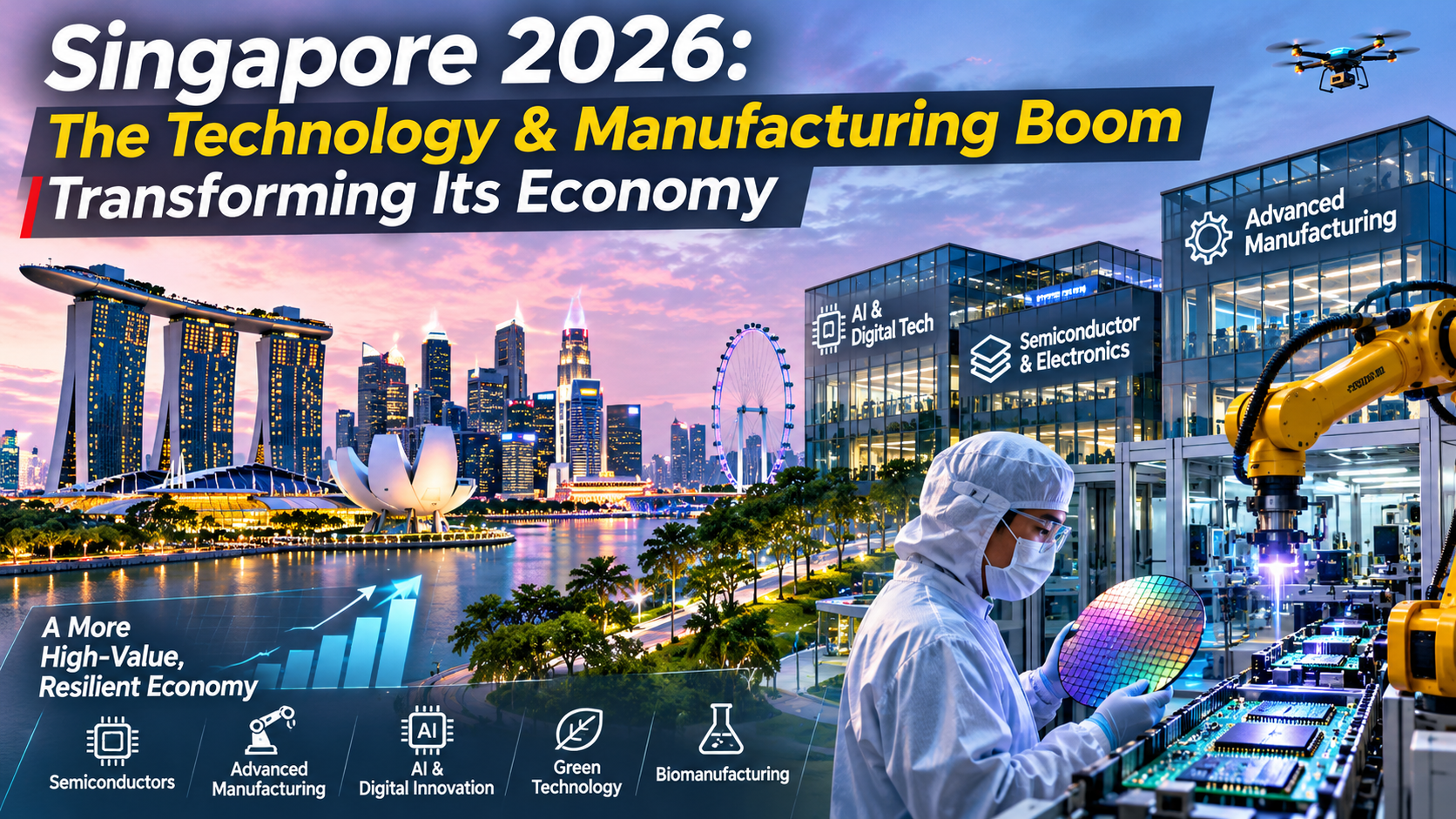
Despite its limited geographical size and natural resources, Singapore continues to strengthen its position in the global economy through strategic planning, skilled talent, modern infrastructure, and a business-friendly environment. Its growing focus on high-value industries is creating new opportunities for businesses, investors, entrepreneurs, and international companies.
The combination of technology and manufacturing is becoming a powerful force behind Singapore’s economic development, helping the country move towards a more productive, competitive, and innovation-driven economy.
Technology: The Driving Force Behind Economic Transformation
Technology is playing an increasingly important role in Singapore’s economic expansion. Businesses across finance, healthcare, logistics, retail, and manufacturing are adopting digital solutions to improve productivity, reduce operational costs, and deliver better services.
Artificial intelligence, cloud computing, cybersecurity, data analytics, and automation are transforming how companies operate. Singapore is also strengthening its digital ecosystem by encouraging research, innovation, and collaboration between technology companies, universities, and government institutions.
AI is particularly important because it allows businesses to analyse information more efficiently, automate repetitive tasks, improve decision-making, and develop new products and services.
For Singapore, technology is not simply an emerging industry; it is becoming a foundation for long-term economic competitiveness.
Advanced Manufacturing: Building the Industries of Tomorrow
Manufacturing remains an important pillar of Singapore’s economy. However, the sector is evolving beyond traditional industrial production towards sophisticated, technology-driven operations.
Industries such as semiconductors, electronics, pharmaceuticals, precision engineering, and biomedical manufacturing are contributing to Singapore’s industrial strength.
Factories are increasingly integrating robotics, smart sensors, artificial intelligence, and automated production systems. These technologies help manufacturers improve quality, increase efficiency, and respond more quickly to international market demand.
Singapore’s semiconductor ecosystem is particularly significant because advanced chips are essential for AI systems, smartphones, data centres, electric vehicles, and modern industrial equipment.
By investing in advanced manufacturing capabilities, Singapore is strengthening its position in global supply chains.
Artificial Intelligence and the Semiconductor Industry
One of the most promising areas of Singapore’s economic development in 2026 is the growing relationship between artificial intelligence and semiconductor manufacturing.
As demand for AI-powered applications increases worldwide, the need for advanced computer chips, high-performance processors, memory components, and data-centre infrastructure is also expanding.
Singapore is well positioned to benefit from this development because it has an established semiconductor ecosystem, specialised engineering talent, research facilities, and international manufacturing partnerships.
The country is also encouraging companies to explore AI applications within industrial production. Predictive maintenance, intelligent quality inspection, automated production planning, and robotics are helping manufacturers create more efficient factories.
This transformation is important because it allows Singapore to compete not only through manufacturing capacity but also through technological expertise and high-value industrial innovation.
Government Investment and Business-Friendly Policies
Government strategy is another important factor supporting Singapore’s economic transformation.
Singapore continues to invest in research, innovation, infrastructure, and workforce development to attract international businesses and encourage domestic companies to expand.
Its Research, Innovation and Enterprise 2030 plan includes S$37 billion in funding for research and innovation, supporting areas such as advanced manufacturing, biomedical sciences, sustainability technologies, and quantum computing.
The government is also promoting AI adoption across industries and supporting businesses in developing advanced technological capabilities.
Initiatives involving the Economic Development Board (EDB), Enterprise Singapore, and A*STAR help companies access research expertise, industrial facilities, innovation partners, and skilled talent.
These efforts strengthen Singapore’s reputation as a destination for international investment and long-term business expansion.
Global Business Expansion and International Investment
Singapore’s economic success is closely connected to its position in international trade and global business networks.
Its strategic location in Southeast Asia, modern port facilities, efficient transport connections, and extensive network of trade agreements make it an attractive location for multinational corporations.
Technology and manufacturing companies are increasingly looking at Singapore as a regional base for research, product development, advanced production, and business management.
The Johor-Singapore Special Economic Zone is another important development. It offers opportunities for companies to connect Singapore’s advanced business ecosystem with manufacturing capacity and industrial opportunities in neighbouring Johor, Malaysia.
This regional partnership could support cross-border investment, logistics, supply-chain development, and employment opportunities.
For international businesses, Singapore offers a valuable combination of regional connectivity, institutional stability, technological capabilities, and access to Asian markets.
The Rise of Smart Factories and Sustainable Industries
The future of manufacturing is increasingly connected to automation, sustainability, and intelligent production systems.
Singapore is encouraging manufacturers to adopt smart-factory technologies that integrate artificial intelligence, robotics, digital twins, and real-time data monitoring.
These technologies can help businesses:
-
Reduce production delays and operational costs.
-
Improve product quality and manufacturing accuracy.
-
Optimise energy and resource consumption.
-
Strengthen supply-chain management.
-
Increase productivity with more efficient processes.
Sustainability is also becoming an important business priority. Manufacturers are exploring energy-efficient equipment, cleaner production methods, and resource-saving technologies.
By combining industrial innovation with environmental responsibility, Singapore aims to build a manufacturing sector that remains competitive while preparing for future sustainability requirements.
Challenges and Opportunities Ahead
Although Singapore’s economic outlook is encouraging, its growth journey is not without challenges.
The country faces international competition for investment, changing global trade conditions, geopolitical uncertainty, rising business costs, and increasing demand for specialised workers.
Rapid technological development also requires companies to continuously upgrade their workforce and business models.
Another challenge is ensuring that smaller businesses can benefit from technological progress rather than allowing advanced innovation to remain concentrated among large corporations.
However, these challenges also create opportunities. Companies that invest in digital transformation, workforce training, research, and advanced production capabilities may become better positioned to compete internationally.
Singapore’s ability to adapt to changing global economic conditions will remain essential to its long-term success.
Singapore’s Economic Outlook for 2026 and Beyond
Singapore’s economic performance in 2026 highlights the growing importance of technology-driven industries.
According to the latest economic update published on 24 November 2026, Singapore’s economy expanded by 6.1% year-on-year in the third quarter of 2026. The Ministry of Trade and Industry upgraded its full-year GDP growth forecast to around 6.0%, reflecting stronger economic performance.
The expansion reflects the contribution of manufacturing, electronics, and technology-related activities, supported by strong international demand for AI-related products and infrastructure.
Looking ahead, Singapore is expected to continue strengthening its capabilities in semiconductor production, artificial intelligence, advanced engineering, digital services, and sustainable industrial development.
Its future economic competitiveness will depend on how effectively businesses combine innovation, investment, skilled talent, and international collaboration.
Conclusion: A Technology-Powered Future for Singapore
Singapore’s economic transformation in 2026 demonstrates how a small nation can build a powerful global position through innovation, strategic investment, and industrial excellence.
Technology is reshaping business operations, while advanced manufacturing is strengthening the country’s role in international supply chains. Artificial intelligence, semiconductor development, automation, and smart factories are opening new opportunities for businesses and investors.
More importantly, Singapore is not simply adapting to global economic changes; it is actively preparing to participate in the industries that will shape the future.
As technology and manufacturing continue to evolve, Singapore’s ability to connect innovation with business expansion could make it an even more influential economic and industrial hub in Asia.
Singapore’s story in 2026 is ultimately a story of transformation where technology creates possibilities, manufacturing builds capabilities, and innovation drives economic progress.


Leave a Reply