

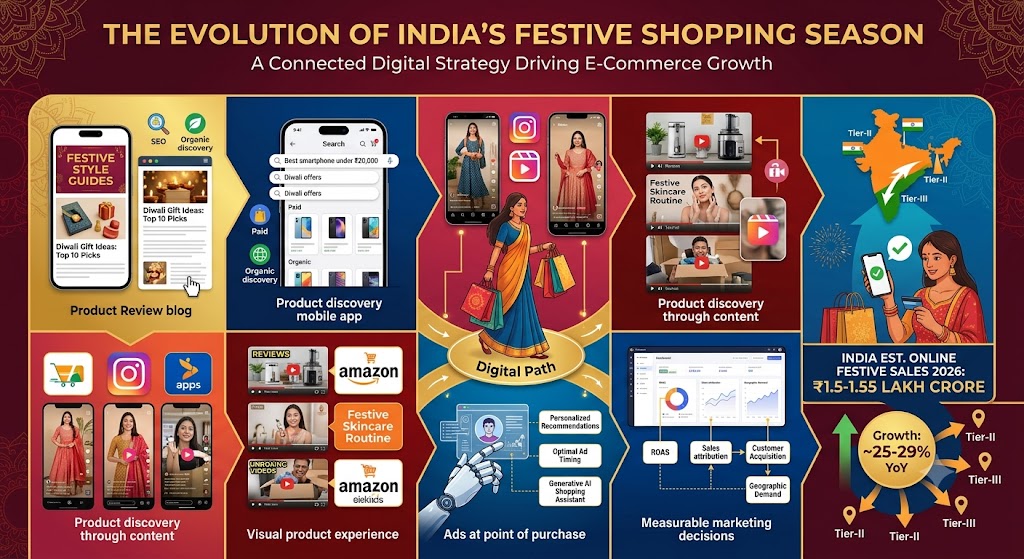
India’s festive shopping season is becoming increasingly digital, changing the way consumers discover products, compare prices and make purchase decisions. For e-commerce companies, the festive period is no longer simply a time for discounts and large sales events. It has become a major marketing window where content, search, social media, influencers, video, artificial intelligence and data-driven advertising work together to turn consumer interest into sales.
This year, the opportunity is particularly significant as India’s festive shopping calendar stretches across several weeks, covering a wide range of national, regional and religious occasions. Industry estimates cited by Financial Express indicate that festive online sales could reach ₹1.5-1.55 lakh crore in 2026, representing growth of around 25-29 per cent over the previous year. Quick commerce is also expected to increase its share of festive online sales.
For e-commerce businesses, this creates a much larger battlefield for customer attention. Consumers are moving between Google searches, social media feeds, videos, marketplaces and brand websites before completing a purchase. As a result, digital marketing is increasingly becoming part of the complete e-commerce business strategy rather than remaining a separate advertising activity.
From Festive Advertising to a Complete Digital Shopping Journey
The role of digital marketing has changed significantly. Earlier, brands could depend heavily on a festive advertisement or a major discount campaign to attract customers. Today, consumers often encounter a product several times before purchasing it.
A shopper may first see a product in a social media video, search for reviews online, read a blog, compare prices on a marketplace and finally purchase through an e-commerce website or quick-commerce platform.
This makes the digital journey continuous.
Google’s latest India festive-shopping insights show that nine out of 10 shoppers who purchased during the Navratri-Diwali period researched beforehand, while shoppers conducted multiple online searches and watched several videos during their buying journey.
For businesses, this means that visibility at only one stage of the customer journey is no longer sufficient. Brands need to remain discoverable throughout the process—from inspiration and research to comparison and purchase.
Blogging Becomes a Tool for Long-Term Customer Discovery
Blogging may appear less immediate than advertising, but it can play an important role in festive e-commerce.
Consumers increasingly search for information before spending money, particularly on higher-value products such as electronics, fashion, appliances, beauty products and home décor. Blogs can answer these questions while bringing potential customers to a brand’s website.
Festive content can include gift guides, buying guides, product comparisons, styling ideas, festival preparation tips, home décor inspiration and product-use information.
For example, a fashion company can create content around festive styling, while an electronics retailer can publish guides comparing televisions, smartphones or home appliances. A beauty brand can use blogs to discuss festive skincare and makeup routines.
The business objective is not simply to generate page views. It is to bring relevant consumers into the sales funnel and move them towards products and services.
Search Marketing Captures Customers When Demand Is High
Search marketing becomes particularly important during festive periods because consumer intent rises.
When people search for terms such as “Diwali offers”, “best festive gifts”, “best smartphone under…” or “festive ethnic wear”, they are already showing an interest in purchasing.
SEO helps brands appear organically for relevant searches, while paid search advertising allows companies to compete for high-intent queries.
The combination is powerful because consumers can move quickly from search to product page and from product page to checkout.
Google’s 2026 festive research found that shoppers often conduct extensive online research before buying, highlighting why search visibility remains an important part of the festive customer journey.
Social Media Is Becoming the New Digital Storefront
Social media is also changing how products are discovered.
Short-form videos, reels, creator content, product demonstrations and live commerce allow brands to present products in a more visual and relatable way. Instead of waiting for consumers to visit an online store, brands can introduce products while people are browsing their social feeds.
A 2026 Meta-Retailers Association of India study said social media influences a significant share of retail purchase decisions and highlighted the growing role of short-form video, creators and messaging platforms in product discovery.
This is particularly relevant during festivals because consumers are already looking for inspiration—whether for clothing, gifts, home decoration, beauty products or food.
Social media therefore performs two functions: it creates demand and helps convert that demand into measurable shopping activity.
Influencers Bring Products Closer to Consumers
Influencer marketing has become another important part of the e-commerce ecosystem.
Consumers often respond differently to a product demonstration by a creator than to a conventional advertisement. Fashion creators can show how an outfit looks, beauty creators can demonstrate a product, and technology creators can explain features.
For businesses, creator partnerships can also provide access to specific communities and regional audiences.
The opportunity is particularly strong in India’s Tier-II and Tier-III markets, where regional-language content and local creators can help brands connect with consumers more naturally.
Video Is Turning Product Discovery Into Product Experience
Video marketing is becoming increasingly important because consumers want to see products before purchasing them.
A photograph can show what a product looks like, but video can demonstrate how it works, how it fits or how it can be used.
During the festive season, this becomes especially valuable for fashion, beauty, electronics, home appliances and lifestyle categories.
Google’s 2026 festive consumer research found that online video is an important part of festive shopping journeys, while short-form video is particularly relevant for spontaneous purchases.
For e-commerce companies, this creates an opportunity to make product pages, social media campaigns and advertising more visual and interactive.
Retail Media Is Creating a New Revenue Stream
One of the biggest developments in the digital commerce ecosystem is the growth of retail media.
E-commerce marketplaces and quick-commerce platforms increasingly allow brands to advertise directly where consumers are already shopping. This gives advertisers access to valuable first-party shopping data and allows campaigns to be linked more closely with actual transactions.
Industry estimates cited by the Economic Times suggest that India’s e-commerce advertising spending could rise 27 per cent year-on-year to around ₹30,091 crore in 2026, as brands increasingly seek advertising formats that connect exposure with transactions.
This is changing the economics of digital advertising. Advertising is increasingly being evaluated not only by impressions and clicks, but also by sales, customer acquisition and return on marketing investment.
AI Is Adding a New Layer to E-Commerce Marketing
Artificial intelligence is becoming another important component of festive digital marketing.
AI can help businesses analyse consumer behaviour, personalise recommendations, create marketing content, optimise advertising campaigns and respond to changing demand.
More importantly, consumers themselves are beginning to use AI while shopping. Google’s 2026 festive research found that Indian shoppers used generative AI tools multiple times during their Navratri-Diwali shopping journeys, with many users saying AI helped them make decisions and shorten the time needed to decide.
This could change the way brands think about search visibility. Businesses may increasingly need content that can be easily understood not only by traditional search engines but also by AI-powered discovery tools.
Data Is Becoming the Link Between Marketing and Business
The real strength of digital marketing lies in measurable data.
Businesses can track which advertisement generated a visit, which product attracted attention, where customers dropped out of the buying process and which campaigns resulted in actual sales.
During the festive season, this information becomes particularly valuable because consumer demand can change rapidly.
If a particular product starts trending, companies can increase advertising around it. If a campaign produces traffic but few purchases, budgets can be redirected. If customers from a particular region show stronger demand, businesses can customise content, offers and inventory accordingly.
This creates a direct link between marketing decisions and business management.
Festive Marketing Is Also Expanding the E-Commerce Economy
The growing role of digital marketing is creating opportunities beyond large e-commerce platforms.
Digital agencies, content creators, photographers, videographers, SEO professionals, performance marketers, graphic designers, influencers, technology companies and logistics providers are all becoming part of the wider e-commerce ecosystem.
Small and medium businesses can also use digital platforms to compete for festive demand without maintaining large physical retail networks.
A local fashion label, handicraft seller or food business can use social media, search marketing and marketplace platforms to reach customers across different cities.
This makes digital marketing particularly important for entrepreneurship and the expansion of India’s digital commerce economy.
Tier-II and Tier-III Cities Become Important Growth Markets
Another major change is the growing importance of consumers outside India’s largest cities.
Recent festive-commerce reporting indicates that non-metro markets are becoming an important source of online demand, while brands are increasingly using regional campaigns, local creators and targeted digital strategies to reach these consumers.
For e-commerce companies, this means festive marketing cannot rely on a single national message.
Regional languages, local festivals, culturally relevant content and location-based offers can make campaigns more effective and help businesses reach new customer groups.
The Business Objective: From Traffic to Sustainable Growth
The ultimate objective of festive digital marketing is not simply to generate clicks or social media followers.
Businesses want to increase sales, customer acquisition, average order value, repeat purchases and long-term customer loyalty.
That requires a connected strategy.
Blogging and SEO can create organic visibility. Search advertising can capture purchase intent. Social media can generate discovery. Influencers can build trust. Video can demonstrate products. Retail media can capture shoppers at the point of purchase. AI and data can personalise the experience.
Together, these channels create a digital sales ecosystem.
The Future of Festive E-Commerce
India’s festive shopping market is becoming increasingly competitive, and the consumer journey is becoming more complex. The days when a single advertisement and a large discount could drive the entire festive campaign are gradually giving way to an integrated digital approach.
The businesses that understand this shift can use the festive season not only to increase short-term sales but also to acquire new customers, strengthen their brands and build valuable consumer data for the future.
As India’s e-commerce market expands, digital marketing will increasingly function as the bridge between consumer demand and business growth.
The festive season therefore represents more than a period of higher shopping. It is becoming a major testing ground for how effectively businesses can combine content, search, social media, video, influencers, AI, retail media and data to turn consumer attention into sustainable economic value.

Leave a Reply