

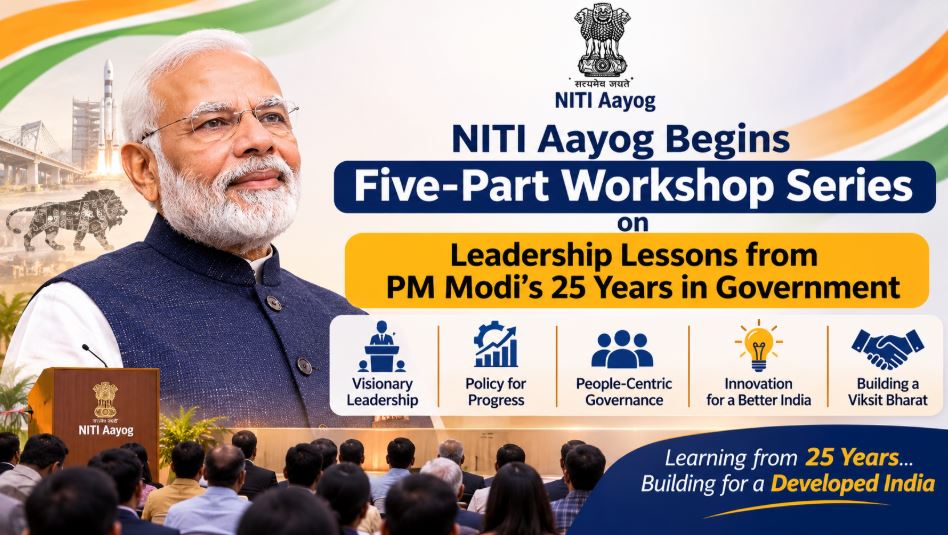
New Delhi, Nov 17: NITI Aayog on Monday organised the first national workshop on “Leadership as a Mission” at Bharat Mandapam, New Delhi, to examine the governance experiences and leadership lessons from Prime Minister Narendra Modi’s 25 years as head of government.
Representational Image
The workshop brought together more than 900 participants, including senior Union and state government officials, district collectors from Aspirational Districts, academics, university students and representatives of communities benefiting from government programmes. Around 250 participants took part directly in the deliberations.
Principal Secretary to the Prime Minister P.K. Mishra delivered the inaugural keynote address, highlighting how decisive leadership and mission-oriented administration have shaped major national initiatives — from the reconstruction of earthquake-hit Kutch in 2001 to India’s response to the COVID-19 pandemic, the expansion of the space sector and the Lakhpati Didi initiative.
The programme is the first in a series of five national workshops intended to convert experiences from Modi’s tenure as Gujarat Chief Minister, beginning in October 2001, and as Prime Minister from May 2014 into structured learning material for future administrators and institutions.
From leadership experience to institutional learning
NITI Aayog CEO Anurag Jain said the central objective was to document lessons from the Prime Minister’s leadership journey and translate them into institutional knowledge.
He outlined four broad principles emerging from the experience: placing purpose above position, replacing a command-based approach with a culture of service, drawing resilience from conviction, and building institutions and teams capable of sustaining progress beyond individual leadership.
These principles were discussed in the context of governance approaches such as Antyodaya, Jan Bhagidari and the vision of Sabka Saath, Sabka Vikas, Sabka Vishwas and Sabka Prayas.
NITI Aayog Vice Chairman Ashok Kumar Lahiri, in his opening remarks, stressed the importance of political and administrative leadership in achieving India’s development ambitions. He also referred to the country’s long-term goal of becoming a developed nation by 2047.
Lahiri outlined an integrated economic roadmap envisaging a $30-40 trillion economy by 2047, with per capita income of $15,000-$18,000 and sustained annual real GDP growth of 7-10%.
Kutch reconstruction, COVID response and women’s empowerment in focus
Mishra cited several major governance experiences to illustrate how political direction, administrative coordination and public participation can translate policy objectives into outcomes.
The examples included the response to the 2001 Kutch earthquake, the coordinated management of the COVID-19 pandemic, India’s growing presence in the global space economy and the Lakhpati Didi programme.
Four speakers shared first-hand accounts during a dedicated session on significant leadership moments.
Rajeev Topno, Additional Chief Secretary and Principal Secretary of Gujarat’s Health and Family Welfare Department, discussed the reconstruction of Kutch after the 2001 earthquake. He highlighted the role of public participation, institutional capacity, decisive planning and coordination between the state and citizens in rebuilding the region.
Former Union Health Secretary Preeti Sudan spoke about India’s COVID-19 response, describing how government coordination, technology and public participation supported the country’s pandemic management. She also highlighted Vaccine Maitri, through which India supplied approximately 300 million vaccine doses to more than 100 countries.
Former Rural Development Secretary Shailesh Kumar Singh discussed the Lakhpati Didi initiative, emphasising its role in recognising rural women as entrepreneurs, producers and service providers. He said the programme’s broader significance extended beyond income generation to economic independence, dignity and social recognition.
Former ISRO Chairman S. Somanath examined the changing role of the private sector in India’s space economy. He highlighted the opening of new opportunities through liberalised foreign direct investment norms and ISRO’s support to private players through its technical expertise, infrastructure and facilities.
Case studies to support civil services training
A key component of the workshop was the Case Clinic, where mixed groups of government officers, community representatives and students examined specific governance decisions and their outcomes.
Each group was guided by a case writer trained under the Capacity Building Commission’s Amrit Gyaan Kosh initiative. The discussions followed a five-stage framework — Learn, Analyse, Reflect, Apply and Commit — designed to connect real-world administrative experiences with practical leadership lessons.
The case studies developed from these discussions, along with accounts shared by speakers, will be made available on the iGOT Karmayogi platform. They are intended for use by civil servants, administrative training institutes, universities and other educational institutions.
The proceedings were also streamed through the iGOT Karmayogi platform and central and state administrative training institutes, enabling officials from across the country to participate.
Leadership lessons linked to Viksit Bharat 2047
The five-workshop series will seek to build an Indian body of knowledge on public leadership, drawing on decisions, institutions and governance experiences from the past 25 years.
The wider objective is to incorporate these lessons into civil services training, academic research and policy discussions as India works towards the Viksit Bharat 2047 vision.
A panel discussion on “Leadership for Viksit Bharat” and an Application Clinic for government officers were also scheduled as part of the programme. Cabinet Secretary T.V. Somanathan was set to launch the Karmayogi Sankalpa and deliver the closing remarks.
By turning administrative experiences into case studies and structured learning resources, NITI Aayog aims to make the workshop series a platform for examining how leadership principles can be applied to the governance challenges of the coming decades.


Leave a Reply